All day I talk to writers and creators, digging into how they can create the work they love, share it in a meaningful way, and truly reach people and have an impact on them.
Today, I want to share three core skills that I encourage writers to consider to reach these goals:
- Give yourself permission to create.
- Treat your writing like an emergency.
- Build a community of support.
If these seem like “soft skills,” I can assure you they aren’t. These are the difficult skills that I have found that professional (and semi-professional!) writers and creators obsess over developing. It is hard work, and they attend to it every day.
These are the skills that matter more than analyzing which email newsletter service to use (spoiler alert: they are largely all the same, just pick one), wrestling over whether to try Facebook ads to promote your book (spoiler alert: spend $20 to take out an ad simply to see how it works), or what engages readers on social media (spoiler alert: dogs. Dogs always work.)
Give Yourself Permission
Most writers and creators I know suffer from impostor’s syndrome at some point in their life. Sometimes, they suffer from it on a daily basis.
It’s the voice that says, “Who do you think you are to write?”
Then comes a long list of logical sounding reasons why that person shouldn’t write. This is unique to each of us, but may include:
- “Only people who have an MFA should write.”
- “Remember that time you wrote that thing that someone made fun of? Why open yourself up to that again?”
- “Shouldn’t you be spending this time with your family, instead of selfishly indulging in writing?”
- “What are you really going to write that is unique? Your ideas are just rehashing what others have already written.”
- “You are too busy for this. Wait until life slows down.”
The list goes on and on. These are the thoughts that many writers struggle with day in and day out. They are the thoughts that can keep you from writing.
It was only later in life that I realized that my parents gave me an immense gift. They gave me the gift of permission. I grew up encouraged to create. My mom was constantly doing craft and art projects of her own, from cross-stitch to painting, and more. My dad and mom were always running these little side businesses: a stamp business in the 70s and a baseball card business in the 80s.
Again and again, I saw them simply give themselves permission to try something new. Something that required creativity and a little risk. Something that on paper, they weren’t qualified to do. Something that was in addition to their busy day-jobs and other responsibilities.
Because of this, I grew up as the “art kid.” I was always creating something, and my parents allowed me to go to a small local art school starting when I was very young, I think I was 5 when it started, but I’d have to call them to double-check.
I always felt I had permission to create.
Now, years later after having worked worked with thousands of writers and creators, I realize how rare that is. That most people struggle with that first step: allowing themselves to even try working on a creative idea.
While I can’t go back to the 1970s, and carefully encourage you to create day-by-day as my parents did, I can sit here today and simply tell you: you have permission. The only person you need permission from is yourself.
Be generous with yourself. Give yourself that permission to create.
Treat Your Writing Like an Emergency
Stop treating your writing and your creative work like a 3rd rate hobby. Like something that is the lowest of low priorities, that is easily jettisoned from your day at the slightest distraction.
Instead, treat your writing like an emergency. That if you don’t create now… it may never happen. And the your life, and the lives of others will be worse for it.
Extreme? Sure. But let me explain…
I’ve often said, “I don’t believe in balance, I believe in obsession.” What I mean is that most people I know lead extraordinarily busy lives, filled with important responsibilities. They work long hours at a day job. They work hard to care for their family. They have a home to take care of. They need to tend to their own health and the needs of their community.
They try to balance it all.
Yet when I speak to writers who truly write — those who write every day, every week, every month, and every year — they make writing a priority in life.
And they communicate that priority to those around them. It is non-negotiable.
This is a process I have been working recently myself with another creative habit: learning how to play guitar. I’m a year and a half into the process, and each day on my calendar I have four 15-minute appointments: “play guitar.” This adds up to an hour a day. These appointments are mandatory.
This has been the result so far… this is the number of minutes I have practiced guitar each month since I began tracking that data:
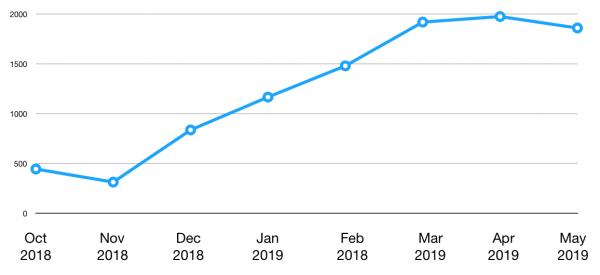
I spent 31 hours last month practicing guitar. I can assure you, I “don’t have the time.” Meaning: my life is very busy running my business, working with writers, caring for my family. If someone had asked me a year ago, “Dan, do you have a spare 31 hours this month” I would have laughed and said, “Of course not! Do you know how busy I am?”
Yet, 15 minutes at a time, I have made this creative practice a priority.
I give myself permission. I allow it to become an obsession.
You can take this even further: make it an emergency. This is what I mean: I follow Kevin Smith on Instagram. He’s best known as a writer and filmmaker, but he does many other creative things as well.
For years I have listened to him share stories with a self-deprecating humor.
Then, on February 26, 2018, after performing one show at a theater, and before performing the next one, he had a massive heart attack. He posted this to social media:
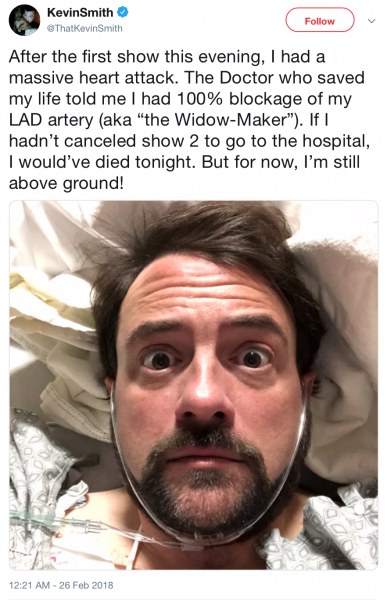
He was 47 years old at the time. What happened next?
He changed everything.
Kevin treated it like an emergency. He started a new health regimen. A couple months later he had lost 32 pounds. Then 43. Then more than 50.
In the process, he became a spokesperson for Weight Watchers and posts constant photos of himself hiking and getting healthy.
This makes me consider: how can we make our creative goals feel like an emergency. How can we find the time and energy to create. Do we have to wait for a crisis in order for this to happen, or can we be proactive about it?
Build a Community of Support
I’ve had the pleasure of interviewing illustrator and author Rebecca Green twice on my podcast, and when she shared this insight recently on Instagram, I took a screenshot to save it:
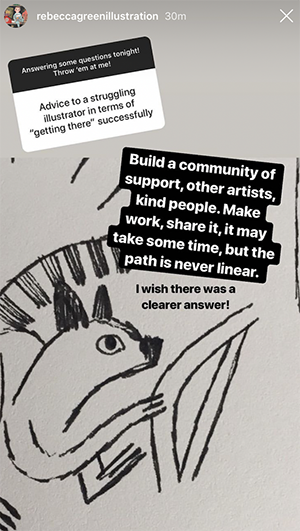
Someone asked her: “Advice to a struggling illustrator in terms of ‘getting there’ successfully?”
Rebecca’s answer: “Build a community of support, other artists, kind people. Make work, share it, it make take some time, but the path is never linear.”
Too many writers and creators work entirely in isolation. As if their creative life is a secret that needs to be hidden from the world.
How did Rebecca develop an audience of more than a quarter million followers on Instagram? I spent hours and hours analyzing it, and the answer I came up with is exactly what Rebecca shared.
She spent years meeting others who create. She did small side collaborations with creators. She shared her work online and off. She showed up to events, workshops, and co-working spaces.
That sounds like a lot of work, right? To get started, I would suggest this: find one person you can talk to about writing or creating.
That’s the start.
One deep conversation. Don’t worry about “followers” on social media. Don’t worry about ROI (return on investment.) Don’t worry if it leads to a review of your book on Amazon.
Just focus on one meaningful conversation around the kind of creative work you love.
Then, do it again. Have another conversation with someone else. That is how you develop a creative community. It’s how you learn to share your own work. It’s how you develop an audience who truly cares about what you create.
If you want help in doing that, or anything I mentioned above, consider joining me in my next Creative Shift Mastermind program which begins July 1. There are only a handful of spots left — join me for three months to establish rock-solid creative habits, define your creative identity, and get radically clear on your priorities. Full info here.
Thanks!
-Dan