Writers: own your connection to readers

My friend Sean Blanda has this expression he’s been using:

“Always Own Your Platform.”

He even has this adorable graphic that he uses when referencing it on Twitter:
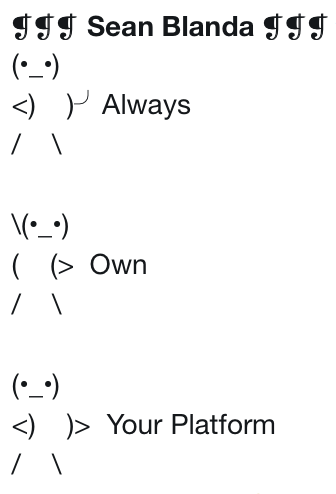
Sean Blanda - Always Own Your Platform

This is general theme I talk to writers about a lot. People can define an author’s platform differently, but I’ve always defined it as:

  1. Communication
  2. Trust

Your ability to effectively communicate with your ideal readers, and in the process, establish a trusting relationship.

I really appreciate the way that Sean frames “owning” this process:

“Always own your platform. Build your audience deliberately and on your own terms. Be in charge of the relationship with your audience.”

Part of his message is that when you develop your connection to your audience on platforms that are owned by others (Facebook, Twitter, Instagram, etc.), then your platform is always at risk. You are one algorithm change, or one marketing change away from completely losing your connection to your audience.

This has been on my mind a lot recently for a few reasons:

  • I have seen writers flood social media in the past decade, leaving behind the idea of blogs. But more and more I hear people talking about a blog renaissance. A return to sharing long-form content on your own website, instead of being beholden to the latest trends and algorithms of social media. For a writer, I’ve always felt as thought blogs were particularly well attuned to their craft.
  • I have sent out a weekly email newsletter for something like 14 years. I still find it to be one of the most powerful ways I connect with people. Chances are, anyone who is reading these very words is doing so because of my newsletter.
  • All I do all day is talk to writers, and I find that they keep telling me how overwhelmed they are in trying to manage all the things they are told they have to do in sharing online.

Perhaps this Onion article headline sums it up: “Guy With 10,000 Tweets, 15 Followers About Ready To Hang It Up.”

In order to really dig into these themes in a useful way for writers, next week I’m going to run a free video series called: TAKE BACK YOUR AUTHOR PLATFORM: WHY BLOGS AND NEWSLETTERS MATTER.

Each day, I’ll share a video and open up discussion on these topics:

  • Day 1: Why blogs and newsletters matter.
  • Day 2: The difference between a blog and a newsletter.
  • Day 3: Why start your blog/newsletter before you have a book.
  • Day 4: How blogs/newsletters help define your author platform.
  • Day 5: Q&A video.

To be a part of it, simply join my Reader Connection Project group on Facebook. It’s free. There are already 600+ writers in there, it’s a wonderful group.

Thanks!
-Dan

P.S. My newest podcast talks about how to develop a non-negotiable creative practice. Listen here.
How to develop a non-negotiable creative practice

In this episode of The Creative Shift podcast, I share my system for how to develop a daily creative practice. For some of you, this may be to double-down on your primary craft, such as your writing or art. But for others, it may help you better stay connected with your ideal audience through your blog, newsletter, podcast or other means. 

You can listen to the podcast by clicking ‘play’ below, or in the following places:

Why I stopped writing

For a very long time, I had established this daily writing habit. First thing in the morning, I would work on my next two books. Often I took a photo of it, which ended up looking something like this:

But last summer I stopped this practice. I stopped working on both books.

Today I want to talk about how this week I started writing again, and how a daily creative practice is the foundation for:

  1. Improving your craft
  2. Living up to your creative vision
  3. Growing your audience
  4. Getting published
  5. Earning revenue from your craft (if you so desire.)

Earlier this week, I opened the file for my book which said “Last Opened August 9, 2018.” Just that simple act felt kinda momentous. Like I was opening the door to some strange new place that was exciting, but terrifying.

Why did I stop writing? Well, I was overwhelmed by editing. You see, writing isn’t a problem for me. I have loads of ideas, and I’m good at living up to a daily writing habit.

What stops me cold is editing. Editing is my kryptonite. That moment when you look at the 70,000 words you wrote, and your pages and pages of notes and research, and you realize: it’s all in the wrong order.

This winter, I felt kinda bad that I had halted work on my next book. To get started again, I looked to my daily guitar practice. Last year, I began by playing at least a minute per day. Now I practice for an hour every day. How do I fit that in? I break it up into 15 minute increments.
I find that 15 minutes is long enough to get value, and short enough to squeeze in throughout the day.

When I considered my writing habit, I asked myself, “Can’t I fit in 15 minutes of writing?”

The answer is clearly “yes.”

To make it even easier, I scheduled those 15 minutes first thing in the day. Before email. Before I attend to the writers I’m working with in my mastermind, my programs, or private clients.

What can come of a simple daily creative habit? Well, let me tell you what happened for one creator who did this…

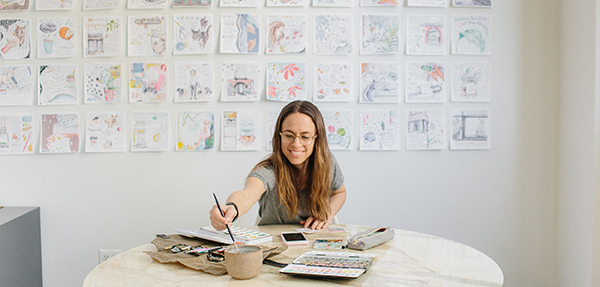
Meet artist, illustrator, and author Samantha Dion Baker:
Samantha Dion Baker

Like all of us, Samantha’s life was super busy with her career, her family, and attending to 1,000 things screaming for her attention each day.

Even though she had an arts background, she found herself tired of looking at screens.

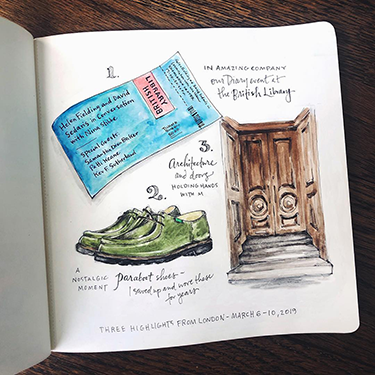
One day, she decided to open up a journal and draw. What did she draw? A moment from her day. Then she did this the next day. And the next. Here is a page from one of her sketch books:

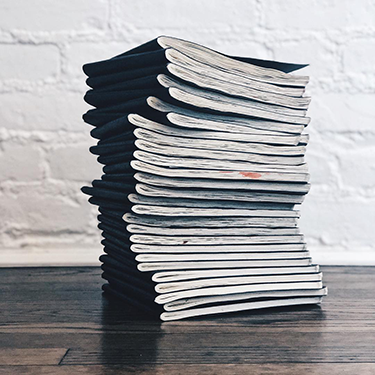
What could this possibly lead to? One small drawing per day? Well, this:

More than 30 sketch books filled. Pretty amazing, right?

But this daily creative practice lead to so much more for Samantha:

  • By sharing her process online, 80,000 people started following her on Instagram.
  • She got a book deal to publish not only her illustrations, but her share her process.
  • She also self-published several other books of her sketches, each of which sold out.
  • Illustration and design clients began seeking her out for private commissions.
  • She created an online store to sell prints and stickers of her work.
  • She began teaching workshops.
  • She now works on all of this as a full-time career, from her private studio in Brooklyn.

She and I sat down this week to chat, and I share our interview in my podcast. You can listen to it here.

The idea of investing in your creative practice has become an obsession of mine. If you would like help in developing your own creative practice, please considering joining me and a small group of other writers and creators in my next Creative Shift Mastermind, which begins April 1.

In the Mastermind you will experience:

  • Daily mentorship from me.
  • A clear step-by-step program to help you establish clarity and habits for your creative process.
  • Accountability with regular check-ins.
  • Collaboration with like-minded writers.

Register now to join us!

What is the smallest action you can take to start your own daily creative practice?

Thanks.
-Dan

“I Needed to Own My Style.” My Interview with Artist and Author Samantha Dion Baker

In this episode of The Creative Shift podcast, artist, illustrator, and author Samantha Dion Baker takes us inside her career. She tells us how a simple daily practice of drawing radically reshaped her career, and helped her stay true to her creative vision. She is the author of the book Draw Your Day. 

You can listen to the podcast by clicking ‘play’ below, or in the following places:

You can find Samantha in the following places:

Even successful writers struggle with this…

Something I obsess about is this idea of a ‘creative shift’ — how someone takes their writing and craft to the next level.

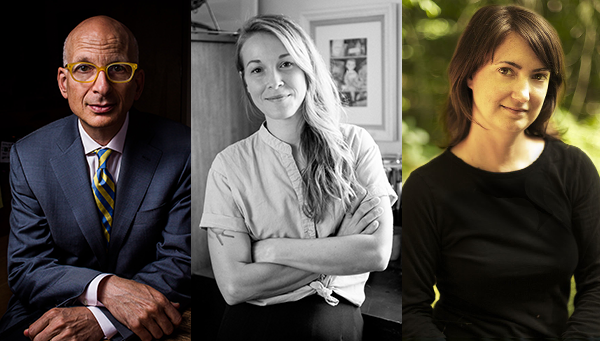
In the past week or so, I shared podcast interviews with three successful authors, and each shared something that may surprise you:

  • Seth Godin: Before he became the bestselling author we know today, he published hundreds of books for others, and launched multiple companies.
  • Rebecca Green: Even though she has more than a quarter million Instagram followers, she has a love/hate relationship with social media.
  • Miranda Beverly-Whittemore: Having her novel land on the New York Times bestseller list doesn’t remove the possibility of despair, exhaustion, and doubt in the creative process.


(Links to these podcasts below.)

These were each long conversations, and they are wonderful reminders that there isn’t a simple path to success with your creative work. For what Seth, Rebecca, and Miranda each shared, they (each in their own way) highlighted the value of:

  • Having collaborators to help you stay focused and work through difficult decisions or challenges.
  • Continually reassessing the creative clarity that drives you.
  • Establishing creative routines, even amidst your otherwise busy life.

None of these things are one-and-done decisions. They are creative practices that you need to attend to each day, each week, each year.

Earlier this week I ran an online workshop for the attendees of University of Wisconsin-Madison’s Writers’ Institute. They are such a wonderful community of writers!

One person asked a question in the Q&A portion (I’m paraphrasing):

“If an author just finished writing their first book, aren’t their efforts better spent learning the craft of writing for the 2nd book, instead of focusing on marketing?”

My reply was: “I love the idea of focusing on craft first. Except what I find is that many authors struggle to establish a writing practice. Instead, they “kinda” write. They write when they have spare time. When everything else gets done first: the dishes, that new series they are watching on Netflix, when they feel confident, when everything is just right. In the end, they end up not focusing on the foundations of marketing (communication and trust with their ideal reader), nor do they really get the writing done. They get stuck in creative limbo.”

Now, all I do all day is talk to writers and creators. I literally sit in this room from around 6am – 5pm and talk to them on the phone, on Skype, in email, on Slack, on Zoom, and through social media:

What I hear is their struggle to establish a creative practice. Not just beginners, but those who have created for years. We work through strategies and tactics to make writing and creating central to their life, and then connect their work to readers via human-centered marketing.

Honestly, a lot of this has become the foundation for my three-month Creative Shift Mastermind program as well. We dig into:

  • How to establish rock-solid creative habits.
  • How to define your creative identity.
  • How to get radically clear on your priorities of what to work on and why.

Instead of struggling alone with these things, I work directly with you as mentor — every day — and you are joined by a group of 9 other motivated writers and creators just like you.

I’ve run this program again and again, and have found that it makes a profound difference on people’s ability to create and connect with their ideal audience.

The doors are now open for Creative Shift Mastermind session that begins on April 1st. If you are curious, check it out here.

Also: the links to the podcast episodes I mentioned are below.

Thanks!
-Dan

P.S. Here are the links to the podcast episodes mentioned above: