
One year ago I set a goal for myself: finally learn how to properly play the guitar by practicing every single day for a year.
Today I want to share what that process has taught me about what it takes to establish a creative habit, reach your goals, and share your work. The insights below be applied to any creative craft, including writing.
If you are like me, you may have found it difficult to establish a solid routine with your writing or creative work amidst an otherwise busy life. In March of 1991, my parents bought me my first guitar. For a quarter century I dabbled with it off and on. Sometimes I would learn a few of the basic chords, then I would take three years off, forgetting everything I learned. The guitar would sit for years in storage, only to be brought out again for a feeble attempt at learning it.
My days are spent with writers, helping them to put writing first, and then developing meaningful connections to their audience. This year of playing guitar every day has taught me a lot about how to ensure you can reach your creative goals.
Let’s dig in…
Step #1: Get Out of Your Own Way.
Working with writers and artists, I have seen the clever ways that we can distract ourselves from creating. Creative work can scare us, inviting in judgement and fear of who we are, what we are capable of, and how the world sees us.
So sometimes we avoid the real work — writing and sharing — with all kinds of smart-sounding excuses and activities.
For me with guitar, I had become a Jedi Master of sabotaging myself.
In college, I was in a band, where I mostly made strange noises on a keyboard, or would repeat the E and A chord on a guitar with lots of buzzing and mistakes.
My friends and I would practice twice a week, but most of that time was spent at local music stores checking if any interesting used gear came in. The ease and thrill of the hunt for gear was more enticing than trying to learn how to play.
I would get caught up in the planning and preparing to make music, fiddling with knobs and dials, all at the expense of craft.
Nowadays, these distractions are compounded by the web, where we can immerse ourselves in blogs, podcasts and videos that feel like we are learning.
For my goal of practicing guitar every day this past year, I needed to get out of my own way. So I told myself that I wasn’t allowed to buy new guitar gear until I have practiced every day for a year. That removed a lot of distraction, and allowed me to put my full focus on the next step.
For your creative goals, I want to encourage you to remove your biggest distractions, even if you can justify that they somehow help. Often, we describe our barriers as outside of ourselves, yet the opposite is often true. Analyze what really keeps you from creating, then challenge yourself to rewrite the script.
Step #2: Practice.
To help me learn guitar, I have relied on some instructional videos from four or five different teachers. Every time a guitar instructor talked about how they learned to play, I heard the same line again and again: “I would spend 10 hours a day practicing. For years.”
They would share stories of how they would struggle with an aspect of guitar, and the only way to solve it was hours and hours of rote practice. To me, this was terrifying because it was a reminder that the only thing standing between me and my guitar dreams was practice.
There wasn’t a shortcut, a piece of gear, a hack, to what I wanted. That made me resign myself to focus on the basics: practice.
Step #3: Create Ridiculously Simple Rules to Succeed.
I created a simple rule to define my year of guitar playing: I must practice each and ever day for at least one minute.
That’s it.
The one minute rule was meant to make it ridiculously easy for me to find success. There isn’t a single day where I couldn’t justify picking up the guitar and strumming a G chord for 60 seconds. Some days, that is honestly all I did.
To make it easy, I placed a guitar within arms reach of two places I am very often:
1. In my home office
2. In my private studio
In fact, I own four “good” guitars, meaning there is never an excuse to not be near one. In the attic, I even have a few crappy guitars that I picked up at yard sales. The kind of guitar that I could take somewhere and lose it and never worry about it.
When I speak to writers who are able to write book after book, they tell me about all of the ways they surround themselves with tools to write: a laptop, an app on their phone, in a pocket notebook, dictation software, and the like.
No matter where they are or what they are doing, they make it possible to write because they make the creative process easy and accessible.
If you tell yourself that you can only create on a single computer, with Scrivener loaded, with access to all of your research and notes, when you are alone, at a time of day when you are inspired, and when nothing else is going wrong in your life, you are basically setting yourself up for failure. Because every star has to be aligned in order to write.
Instead: take control of your ability to create and identify small ways you can create wherever you are.
Step #4: Track Your Progress.
In the first weeks of practicing, I would see how many times I could move from one chord to another. What I found is that on the first day, I could switch from an A chord to a D chord 15 times in a minute.
A week later, if you asked me how I felt about my guitar playing, I would tell you that I was still horrible. But my feelings overshadowed my true progress. When I looked at the chart where I tracked progress, I was astounded: I could now play the same chord change 41 times in a single minute. For that one skill, I had improved nearly 300%!
That is the power of tracking things. Don’t just rely on your feelings to measure progress. I have spoken to writers who have published multiple books who still say, “I’m not a real author yet.”
For my “minimum of 1-minute per day” rule, this was my reality on many days:
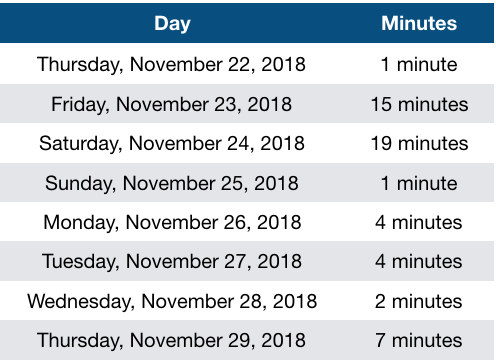
It seems silly to see how little I practiced on some days. Yet, one thing I don’t feel is any shame that I haven’t practiced. When I look at this chart, what I know is that I showed up each and every day to this craft. While I may sometimes feel progress is slow, I am reminded every day that progress must be happening.
It took me eight months to feel, “OMG, I’m actually going to learn to play guitar!” That is 240 days in a row of practicing before I finally felt that.
Do you have to be obsessive about tracking? No. But I have found that helped me stay connected to my craft, even when I worried I wasn’t doing enough.
Step #5: Invest in Collaborators
After a year of playing every day, I’m coming to terms with the fact that I’m hitting a wall in my guitar practice routine. I have all of these disparate skills that haven’t allowed me to feel fluent in my playing.
I have plateaued because I’m falling into familiar routines with my playing, and I’m not sure how to break out of them.
I thought about buying new gear, but I realize that what I need is an expert to guide me and accountability to help me keep momentum.
So I am investing in a collaborator.
I hired a guitar teacher whose videos I have enjoyed on YouTube. He literally lives on the other side of the world from me in New Zealand, but once per week we have a live session together via video Skype.
What I’m realizing is this: access to information is not what is tripping me up. In fact, I’m drowning in information. YouTube is filled with tens of thousands of high quality instructional videos.
What I am missing is a guide: someone who can pull together my skills and give me a clear direction, and provide accountability.
That is the value of working with a collaborator or support group.
It’s funny, everything I’ve been experiencing above is also what I bake into my Creative Shift Mastermind. It’s a great reminder that making your writing a priority is really a process of: clarity, simple steps, accountability, mentorship, and a true creative community to help you get there
Thanks.
-Dan
 “I am inspired by the amazing folks in this Mastermind. The adage that you become who you hang out with is true and I can become a better writer and creative person by spending time with this group. This Mastermind is far more than I imagined it could be.”
 “I thought I’d signed up for the Mastermind to get my career back on track. Seems like we’ve delved into getting my whole life onto a better track.”
 “This Mastermind has given me a sense of direction with the business side of my writing that I’ve never had before.”
 “In the Mastermind I have gone through profound creative growth. I learned new things about myself, making experiential, intellectual and emotional connections that surprised me and enriched me. That’s the secret power that Dan’s Mastermind unleashes. He is a master weaver of collaboration. Magic occurs in the Mastermind.”
 “Dan’s encouragement and insights helped me to change my approach to connecting with my readers and my community. He helped me stay true to my values and my self.”
 “I started the Mastermind because I was stuck. I thought about writing all the time–but I didn’t actually write. Dan and the Mastermind of creatives helped me get out of this tremendous slump and into the most productive creative period I’ve ever experienced. I’m writing, I’m submitting, I’m confident. The Mastermind is a priceless experience.”