What is the value of having social media followers?

In the past few issues of this newsletter I talked about different ways of considering using social media if you are a writer or creator:

One of the main point’s I’ve made is to stop thinking about social media as being just about growing how many followers you have. But today I want to talk about the opposite: why having followers on social media can matter to your goals as a writer. The context I’m talking about here is why could it possibly matter that you have 100, or 1,000, or 10,000 followers on a specific social media channel? What is the actual value in doing so, beyond just “big numbers are impressive?” (You all know how I feel about math.)

Let’s dig in…

Followers Can Provide Credibility

Having followers can help give you credibility. What is “credibility” in this case? Here’s one version: that you are a real person who writes about certain topics you care for deeply, and who is connecting with others in a professional manner. Let’s consider some simple use cases here. Let’s say you reach out to another author asking if they would consider writing a blurb for your book; or you pitch yourself as a guest on a podcast; or you query an agent; or you connect with an organizer of a local literary festival to see if you can speak on a panel. When you have followers, this is how it can help with establishing credibility:

  • They an understand who you are on a human level and a professional level. That you are somehow active online and show up as a real person. You get to define that in manner that feels safe and comfortable to you, but a simple way to consider that is that they see you actually are a real person, and not some bot. Maybe they see your face, and that you love books and writing, and that care as deeply about certain themes in books as they do.
  • They see that other people recognize and connect with you. This is a form of social proof that you are part of a community, and engaging with you is “safe” in this context.
  • They can see how you engage with others. The frequency, the tone, the style, and the way others do so with you.

I always remembered advice about going on job interviews from decades ago, things such as: look the person in the eye when talking, give a firm handshake, sit up straight, dress professionally, send a thank you note, etc. All of these were other ways of illustrating that I was a viable candidate, and this type of stuff seemed to matter just as much as what was printed on the resume.

Sure, having followers can attempt to put a numeric value indicating how big your network is. But it can also illustrate credibility in other ways.

Followers Can Hint That You Have Access

Who you have access to is something that others may be attracted to. For instance, if they can see that you are a part of a certain circle of writers, or that you speak to a lot of book clubs, or you do a lot of school visits as an author. Having followers can hint that you have access. Sometimes this is merely for social reasons, someone wanting to feel a part of a community that you are a part of, or seeing that readers like you and therefore they want to be associated with you. But it can also apply to professional goals: a podcaster may more easily book you as a guest if they see you have a lot of followers because they make some quick assumptions in their head:

  • This person is the real deal (see “credibility” above)
  • This person has access to a lot of people, giving me the social proof I need to trust them
  • This person can potentially share the podcast episode we record to their many followers, thereby making the episode a success, but also potentially helping my podcast grow

Sometimes people aren’t even consciously aware they are thinking these things when seeing how many followers you have. Other times they are. I’ve certainly heard of nonfiction or memoir writers who got a book deal very quickly because of how many followers they have. It was enough for a publisher to consider: “they have access to the exact right audience, this is a good business move for us.”

Followers Show You Have Reach

This is perhaps the most obvious thing that having followers shows: that you can reach a certain number of people. What is “reach”? That if you post something, it has a good chance of reaching X number of people. Years ago, this was very rare and highly valuable. One company I worked for had a (supposedly highly profitable) division that sold lists. What are “lists?” Lists of email addresses. So if you were a company that wanted to reach “C-suite executives in the refrigeration industry,” you would pay a lot of money to get a list of email addresses to reach them.

But now everyday I see individuals on Instagram and TikTok who post about books and reading, who have thousands of followers. That reach is still very valuable, and getting it is more accessible than ever before. In some ways, one could consider that having access to a large group of people has many benefits from a business standpoint, from a community standpoint, and a personal standpoint.

Reach can also indicate that you have the power to gather people. That if you held a meetup event for your followers, that people would be there. We can think of this in simple terms, like how back in the 1990s I would host parties with friends because each of us could invite 50 people, thereby guaranteeing that at the very least we would end up with dozens of people attending. The same holds true for hosting a book event with multiple authors, or doing an “in conversation” event, instead of just a book reading where you are the only author on stage. One is not better than the other. But the “reach” can be greater. Sometimes more is… well… more.

Followers Indicate You Can Sell Books or Monetize

Having followers can increase your chances of actually selling more books or otherwise monetizing your career as a writer. Now, I’m not saying “social media sells books,” because I have written about that in the past:

But having followers on social media can be a part of a larger ecosystem that can increase book sales. I mean, math can work here. We can math that if you post to social media with 100 followers that your book is on sale today, that you can get 2 sales, and that if you send that same message to 10,000 followers, you will get 200 sales at the same 2% conversion rate.

More followers can move more product. It can also give others the belief that you can move more product, even if the reality is different. Which is the same reason why a billboard in Times Square costs more than a billboard in Howell, New Jersey. The advertiser can assume that if it is seen by more people, it has more potential to sell more product.

But monetization can take other forms as well. Having more followers can allow you to monetize in additional ways:

  1. Creating a paid Substack newsletter
  2. Creating a paid Patreon
  3. Hosting a paid event (online or in-person)
  4. Creating a paid subscription to Instagram
  5. Selling related products
  6. Being a paid speaker

I want to be clear here: you do not need to have a goal of having thousands of followers. All of these same points from above matter if you have 50 followers. Or 150. Or 350. Having those followers can all result in the same benefit of providing credibility, access, reach, and the ability to sell books. I want you to feel good about each connection you have with a follower. But I also don’t want to dismiss the value of having a following.

I spend my days working with writers to grow their platforms, reach their ideal readers, and prepare for book launches. And in many of these strategies we do indeed focus on follower growth, subscriber growth, and how how they can reach a larger audience in specific ways. But I always want to be clear about why these things matter, how you can craft an experience that matters deeply to you, and that they should be in the service of meaningful connections with like-minded readers.

Thanks.

-Dan
Honor your connection to readers (podcast)

I have seen so much discussion recently about social media and email newsletters. Today, I want to encourage something critical: Focus on your goals as a writer and the experiences you want to have with readers. I worry that focusing too much on what each social network provides (the trends, the algorithms, etc.), has us ignoring our own creative vision. And in the process, ignoring the moments that truly matter in living your life as someone who writes, who reads, and who is in conversation with others who write and read.

You can listen to the podcast by clicking ‘play’ below, or in the following places:

You can watch the episode here:

Stop worrying about how many followers you have

Maybe you have heard that if you are a writer, you need to grow your platform in order to develop a readership for your work, or attract agents or publishers. It’s common for me to hear author’s say, “I heard that I need to have 10,000 followers in order to get a publishing deal.”

I don’t think that’s true. So today I want to talk about something in very honest terms, and hopefully flip how you think about this work. To put it bluntly:

Stop worrying about how many followers you have. Stop worrying about how many subscribers you have.

These metrics aren’t the magic solution we tend to think they are. Instead, I want you to consider the experiences you want to create for yourself and your readers, and the specific actions that support your career as a writer.

Let’s dig in…

Stop Worrying About How Many

“More” is not usually the best way to solve your creative challenges or lead you to your creative goals. More followers, more subscribers, more likes, more more more. Can “more” be good. Sure. More connection. More understanding. More awareness. More empathy. More creativity. More fulfillment. “More” has so many great contexts in which it thrives as it relates to your goals as a writer. But more followers isn’t one of them. In fact, I tend to find that the striving for “more followers” can lead to lower levels of clarity and fulfillment as a writer.

Now, I don’t love math, but I’ll math here for a moment just to help illustrate this point. It’s easy to think of math as a solution: “If I had 100,000 followers, then if even 1% of them buy my book, that’s awesome!!!” Plus, if I had 100,000 followers, that means people would see that my words are important. It means agents and publishers would pay attention, that podcasters would book me as a guest in a heartbeat, and that I could get speaking engagements or invites to appear at literary festivals left and right!

This is totally logical: more people looking at you and your work means more possible people who buy your work and elevate your career. But…

What if you had just 290 followers? And 50% (145) of them saw everything you share? And 50% (72 ) of those people commented on your posts, giving you great conversations? And 50% (35) of those people actually read your writing and told their friends about it? And what if you grew this… slowly, maybe 20 new people a month? But in the process, you felt a part of something. And these people felt like they were a part of something with you?

Would that be so bad? To have readers who talk about your work? To be in conversation with like-minded readers and writers? To not always be vying for MORE (in all caps) and feeling less than because you don’t have a huge following?

It’s not uncommon for someone to tell me, “Ugh, I don’t have any following, just 300 people.” Which confounds me. So, 300 people are following you. And let’s just say that 12% of those people (the 35 people from above) actually read your writing and tell others about it. Do those people not exist? Is that not the absolute goal you say you want? But you are ignoring them? (Not you of course, the imaginary writer in this example.)

Another thing we don’t talk about enough is that, well, enough is never enough. I’ve interviewed artist Rebecca Green a few times, and one of her quotes always stuck in my brain. I asked her if she knew how she went from 225,000 Instagram followers to 258,000 a year later. Her reply was so honest with regards to how metrics like these can be confusing: “It’s funny, it seems like a jump from 225,000 – 258,000, but every day I look at it and think, ‘Well, I’m not at 300,000. I’m not at 550,000. I’m not at a million.’ That never stops. I remember when I was like, ‘I got 100 likes, OMG! I rule the world!’ Now, I’m like, OMG, I only got this many people… I try not to let it effect me emotionally. But I would not have a career without Instagram. The way that I grew it was meeting people face to face, moving to new places, and being in a lot of diff industries [such as magazines, books, retail, all sorts of collaborations.]”

That quote is from 2019. Here we are, three years later and Rebecca’s Instagram account currently has 278,000 followers. Which of course, is amazing. And it is still a driving force in her career. Yet… it is still not 300,000. The point is not if a certain number is “good” or “bad.” It is that you can’t assume that a sense of fulfillment will come when you reach a certain number.

This applies to newsletter subscribers as well. So, I’ve sent out this weekly email newsletter for more than 15 years. That means every Friday for me is a deadline. I’m not going to lie, I love it. I love the creative spark that is encouraged by a weekly deadline. I don’t obsess about my newsletter metrics because it is a labor of love. But data does get thrown in my face when I log in. This is what I see for all of my newsletters:

  • Last week’s newsletter: 6 unsubscribers
  • The week before that: 4 unsubscribers
  • The week before that: 4 unsubscribers
  • The week before that: 8 unsubscribers
  • The week before that: 5 unsubscribers
  • The week before that: 1 unsubscribers
  • The week before that: 2 unsubscribers
  • The week before that: 6 unsubscribers
  • The week before that: 6 unsubscribers
  • The week before that: 4 unsubscribers

OMG, what am I doing wrong?! What did I mess up on the week where eight people unsubscribed?!? Why am I failing so much??!?!?!?

🙂

Well, I’m not doing anything wrong. Every week I write, every week I send, every week someone unsubscribes. Which is… GREAT! In fact, that is something to be honored and even celebrated. Someone is taking action to focus their attention on what matters most to them right now. I feel good about that.

Them unsubscribing is them choosing. It is not a reflection on me or my work, and if it is, I don’t have time to worry about it. I spend my week in conversation with writers. My work has me in the trenches with writers, not just sharing theory, but ideating and executing marketing campaigns. So I am always — always — listening to the needs of writers and creators. It’s my passion. I have a clear mission in my work, and I show up to it every day. If that doesn’t help someone through my newsletter, that’s fine. Oh, and it should be noted, each week I gain subscribers too.

As someone who runs a business around what they create, there is something I don’t see discussed enough: you can have a highly profitable business around your craft or art, with a small audience. That’s right, you don’t need 100,000 followers. Or 10,000. You can succeed with a few hundred followers and supporters. The key is this: that they are the supporters who buy your work and/or share it with others.

For some writers I work with who actively support the financial side of their career through their writing, we discuss this often. The concept of what encourages revenue goals, not just vague “follower” goals. That can often be a huge mindset shift, and a positive one.

Are there situations where “how many” can matter? Of course! When I’m working with clients, we will analyze this in terms of their goals, and we can use data to help define some strategic direction. But the point is that this metric shouldn’t overwhelm your sense of purpose or self-esteem. It is just one factor to consider, and rarely the most important.

So what happens when you stop worrying about “how many?” You can instead consider: “what experiences matter to me — and to readers — each week?”

Consider Experiences and Actions That Truly Matter

What is more fun that “followers”? Experiences! Moments! Connections! I mean, this is what life is made up of. I always remembered this 2009 blog post by Bronnie Ware, a palliative care worker who shared her list of the top five regrets of the dying:

  1. “I wish I’d had the courage to live a life true to myself, not the life others expected of me.”
  2. “I wish I hadn’t worked so hard.”
  3. “I wish I’d had the courage to express my feelings.”
  4. “I wish I had stayed in touch with my friends.”
  5. “I wish that I had let myself be happier.”

None of these are about “how many,” but rather, “how deeply.” How deeply we express who we are. How deeply we show up in our community. How deeply we connect with others. How deeply we are present in the moment.

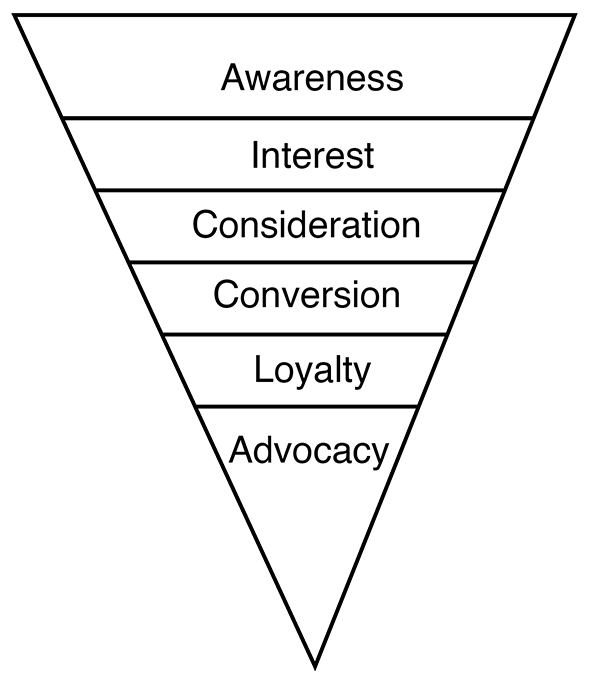
For your experience of being a writer and sharing your work, how can you control that? By focusing on the actions that matter. By crafting the experiences that matter. Since I want this post to be practical in terms of how you can help grow your career as a writer, let’s talk about the marketing funnel for a bit. I know you may be thinking, “Marketing funnel, Dan? Really? Yuk.” But please bear with me. Here is one version of a marketing funnel:

Marketing Funnel


So the theory here is that people become aware of you or your writing at the top of the funnel, then move down it. Over time, they become interested in your writing. They consider if they want to follow or subscribe or buy or read your work, or show up to an event you are speaking at. Then they “convert” which is a sales term where they (perhaps) buy your book. A lot of people think that is the end of the marketing funnel, but it’s just the midway point Beyond that is loyalty: them reading your book, reviewing it, looking for whatever else you create. And then… advocacy. Another way to say that is word-of-mouth marketing. They tell their friends how great your book is.

One way to think about the marketing funnel is math: “IF MORE PEOPLE ENTER THE TOP OF THE FUNNEL, IT WILL LEAD TO MORE BOOK SALES, YES?!?”

I mean, we can make the math work. But that isn’t the only way to view it, and definitely not the best way. Because the funnel is all about moments of human connection and and experience. It is about depth.

When someone chooses to follow you on social media, or subscribe to your newsletter, or buy your book, or read that book, or post a review for it, or tell their local librarian about it, or emails you to tell you they loved it — these are moments where your art has connected with someone’s experience of being alive. It touched them in some way. It is changing them in some way.

What would I love for you to focus on more than just getting more followers? Well, a few things:

  • More creating! Yes, more writing.
  • More connections with like-minded people who love the kind of stories, writing, or art that you do.
  • More conversations around these things.
  • More moments that comprise the life of someone who looks for inspiration, education, and connection around what they create.
  • More actions that support your career as a writer, however you define those goals.

There is one more reason I want to encourage you to stop worrying about how many followers or subscribers you have. It’s because I care about you. I care about your mental health. I’m going to imagine you have a lot of responsibility in life. People you care for. Tasks on your to-do list. The more you add “worry about how many followers I have” to your list, the less likely you are to create. And the less likely you are to share. And the less likely you are to feel good about it. Or to feel good in general.

I want you to stop worrying so you can instead focus on what matters most. And only you can define that for yourself.

Thanks.

-Dan

Honor your connection to readers

I have seen so much discussion recently about social media and email newsletters. Today, I want to encourage something critical: Focus on your goals as a writer and the experiences you want to have with readers. I worry that focusing too much on what each social network provides (the trends, the algorithms, etc.), has us ignoring our own creative vision. And in the process, ignoring the moments that truly matter in living your life as someone who writes, who reads, and who is in conversation with others who write and read.

I’ll put my suggestions up front here, then dig into each more deeply below:

  • “Own” your connection to people who support your work
  • Yes, you can unfollow people
  • Yes, you can talk about yourself
  • Forge the path that makes sense for you

Okay, let’s dig in…

“Own” Your Connection to People Who Support Your Work

Should you leave a certain social network? Or all of them? Should you sign up for one newsletter service? Or another? Regardless of what you choose, I want to encourage you to own the ability to reach those you are connected This could be your professional connections, or writers you met at a retreat last summer, or who you met in a writing class six years ago, or a reader you met at a literary festival, or anyone who supports your work and cares about the themes you write about.

Can you develop your following on Instagram? On Substack? On LinkedIn? Sure. I’m not here to argue for one or the other, you can find endless debate on that elsewhere online. For whatever you choose, I encourage you to:

  1. Work cross-channels. While you can focus primarily on one channel, give people other ways to connect with you as well.
  2. Back up your connections. Don’t assume that some social network will preserve your profile or list of followers. You should have a copy of that.
  3. Be proactive in attending to 1:1 relationships. Stop just looking at your follower count. Show up to engage with others as if they are real people. Because they are.

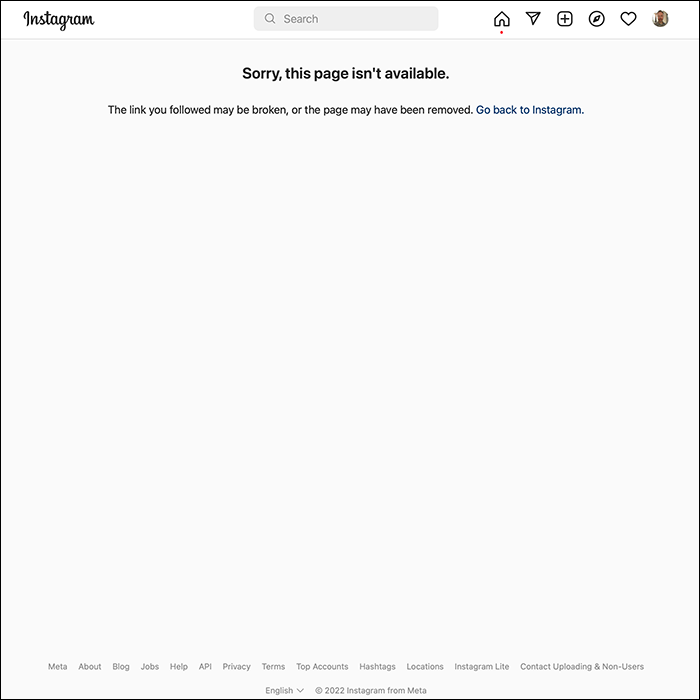
This week an artist I follow (Addie Best) shared something that was scary. You see, for several years now, she has shared her printmaking on Instagram, amassing 44,000 followers, and developing an entire business/career partly through Instagram. Here, let me show you here Instagram account:


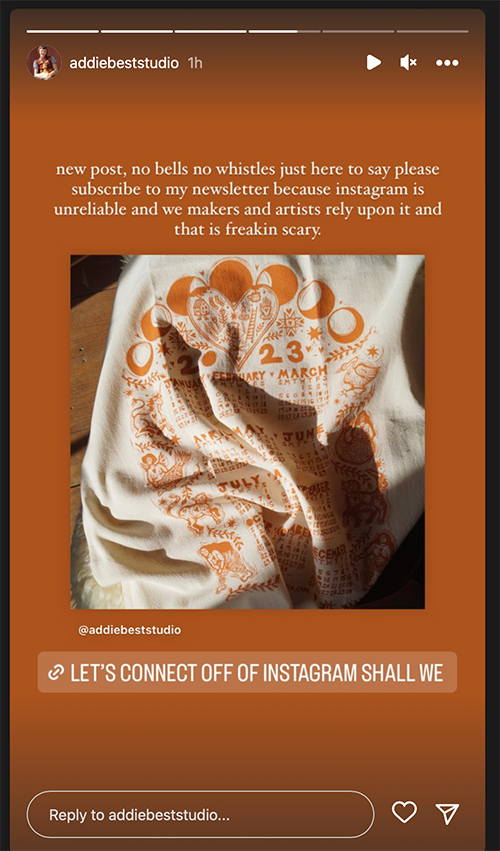
Oh. Wait, that’s not good. That’s right, like many people earlier this week, her account got caught in a glitch, and it was deleted. All of her 700+ posts, all of her 44,000 subscribers, and the primary way she markets her prints. Luckily, her account was back within hours, and then she posted this:


What is she encouraging her followers to do? How is she diversifying the connection to her audience? A few things:

  • The primary one is to encourage people to subscribe to her email newsletter. Why? Because that not only gives her permission to email them, but she “owns” access to their email address. She can use that on any email platform.
  • Support her on Patreon. She has nearly 350 supporters there, and they pay $1 to $20 per month. I have to imagine many of them pay the $10 per month level because that is where you automatically get a block printed patch in the mail, which is one of her biggest sellers.
  • She has an online shop where you can purchase her work, and she is very good about communicating when she will release new products to purchase.
  • She mentioned her dream of being able to directly mail a physical catalog to her supporters. I can honestly see that becoming a reality for her. Again, that would be a direct connection, because she would “own” the right to send you something to your physical address. Which is different that, say, selling through Amazon where the creator doesn’t get the address of the buyer, only Amazon has access to that.

Now, perhaps you don’t have a full-time business like Addie. At the very least, I would encourage you to regularly download your data from any social network you are active on. Yes, all the major social networks allow you to download the content you shared, the information of people who follow you, links to who you follow, etc. I mean, just imagine the difference this makes if a specific social network every just randomly booted you off: having no record of who followed you vs. you having a clear list of those names and links to their accounts.

While you are at it, back up your writing, your photos, etc. I wrote a whole post about this back in March, which I highly recommend you check out: Preserve What You Create.

To me, this is honoring the connection you have with others. Whether they be readers, colleagues, friends, or others. Why offload something so important to some company? That is a responsibility that we should each show up for.

Yes, You Can Unfollow People

Back in 2021, I wrote about a social media reset I was doing. An excerpt: “To optimize my social media for a feeling of deep connection, I had to do something I have resisted for years: unfollow people. In some ways, this has been an arduous process.
So much of being on social media is about wanting to be liked. To hope that others care about what you share, and that in the process, you get to validate the work of others. To unfollow someone feels like the antithesis of all of these things.”

Before that time, and after, I have had periods where I have unfollowed people. It is always — always — something I hesitate to do. But I do it for important reasons:

  1. To respect my own creative goals. I am a big believer in getting clarity on what you create and why, of where you can put your attention, energy, and time. Limits help me focus my day for the moments and experience that fill me up.
  2. To respect others. There is a reality that I simply can’t pay attention to as many people as I would genuinely like to in a day. Years ago, I remember reading about “Dunbar’s Number,” which “suggested cognitive limit to the number of people with whom one can maintain stable social relationships.” (via Wikipedia.) Even for the people I don’t follow, I want to show them respect. I don’t want to follow them in order to pretend I am paying attention, when I’m not. Because that would be like saying, “Oh, I LOVED your book,” when you haven’t read it at all.
  3. To manage my own mental health. I am unbelievably lucky, but I’m also going to be very honest: running a business, raising my 5 year old and 12 year old, showing up for my wife and our home, and attending to my health is a lot. With my limited energy and attention, I can’t do everything I dream of. I have to focus on the things things each day that matter most to me. I can’t “do it all,” and I don’t want to drive myself over an edge trying to.
  4. As I mentioned last week, I feel that limits are powerful drivers to creativity and connection. The idea of “what if I followed only 300 people — or only 100 people — or only 10 people” is a compelling prompt for me to consider in terms of depth of connection, not just breadth. Too often when we discuss social media, we only talk about quantity, not quality. But I’m curious about where limits can take connections that are rare and meaningful.

The other day I was reading an interview in Melinda Wenner Moyer’s newsletter. Author and clinical psychologist Yael Schonbrun introduced this concept builds upon the work of Leidy Klotz of the value of subtraction in our lives. Of focusing on less, not more.

“What the science shows us in terms of the cognitive piece is that we have a hard time doing the action of subtracting, and it’s because it often doesn’t occur to us. We engage in what’s called subtraction neglect. We don’t even think about it. What’s more, when we are overwhelmed, that tendency to neglect subtraction grows stronger. So the busier you are, the less likely you are to take something off your plate, which is really unfortunate.”

It reminded me of a discussion I saw online where one author noticed that another author had unfollowed them, and they weren’t happy about it. A long conversation followed where people commented about the motivation of the author who unfollowed. I don’t know the history of these relationships, but it was fascinating to see how quickly people assigned the act of unfollowing as “obviously” petty, and fueled by a negative intention. Perhaps that was the case in that instance, I have no idea. But I know it’s something people struggle with this, concept of clarity and focus in how they engage. So I simply wanted to encourage you that you can unfollow people. And that it can be a positive act.

Yes, You Can Talk About Yourself

Over the years, I have heard this repeated countless times as people describe what the “best” strategy for using social media is: “Talk about others 90% of time, and yourself 10% of the time.” Of course, I appreciate the place this comes from: the idea that generosity is a critical part of being a part of a community, and that lifting up others prevents social media from becoming a festival of self-promotion.

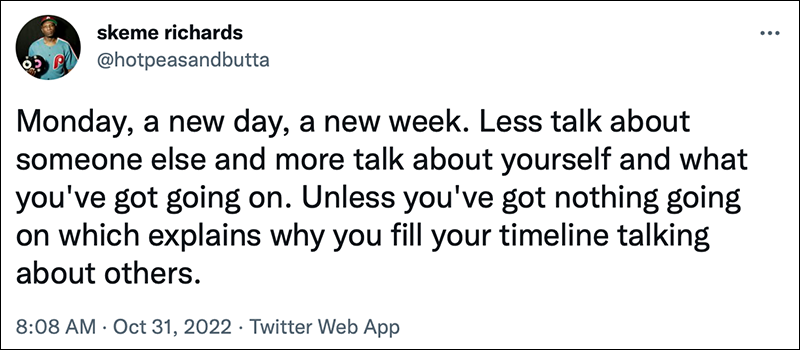
But the other day I saw this Tweet the other day from Skeme Richards:


Now, maybe you agree or maybe you don’t. But it got me thinking.

In conversations I have with writers and creators, something comes up pretty often: a fear of being seen. Sometimes it is expressed as a deep-seated feeling that “I was raised to not talk about myself.” That to not talk about yourself is somehow noble and honorable. And those who talk about themselves are… bad. Bad bad bad people. Other times, that feeling of not wanting to be seen comes up a different way, like how I referenced above, as a strategy for “social media best practices.”

Yet something I was considering as I thought about Skeme’s words is that the people who I love following, spend a lot of time taking about their work, their process, and why they create. People like:

Do they also talk about others in the process? Yes! All the time! But it is in service of creative work and themes that resonate and sharing their life with me. So, why do they talk about themselves? Because they are:

Doing. The. Work.

Day in and day out, they are showing up for their craft. They are in conversation with people. They are making new connections. They are pushing themselves past creative boundaries. They are sharing the sometimes difficult reality of the creative life, not just the highlight reels. This means they are showing the struggles, the nuance, the process, and so much more.

I have done the work I do full-time for 12 years because I deeply admire writers and creators. I get emotional just writing that. For someone to have a creative vision. To take the risk to create. Then, to share. That is what fuels my heart.

So… yes, you can talk about yourself. Because in doing so, you are doing so much more. You are sharing reality of the creative work. You are sharing themes that matter most to you. In doing so, you are giving others permission to share and engage on these same topics that you explore. You are opening up possibility for connections.

Forge the Path That Makes Sense for You

In my book, Be the Gateway, I talk about ignoring best practices. Not that they can’t be useful, but too often, people try to use them as shortcuts, when the reality is that they deliver a fraction of the value they did years ago. I encourage you to find the path for how you share that feels right to you. And sometimes that means you have to see things that others can’t. Even the experts.

I was listening to an interview this week where Matt Damon described a conversation he had with Tom Cruise. You can watch it here, but this is the gist of it:

  • Matt asks Tom how he did a stunt in a Mission Impossible movie, one where he is running along the side of a building at 1,700 feet above the ground, just on a tether.
  • Tom talked about how he had the vision for this stunt for 15 years.
  • When production began, Tom met with the safety guy on the set and described what he wanted to do.
  • The safety guy says, “You can’t do that. That’s too dangerous.”
  • Then Tom continues the story, “So I get another safety guy…”

Meaning: Tom had to find a collaborator who shared his vision for what was possible, even if it broke standard assumptions for what was possible. Now, you may not like Tom Cruise, or this kind of stunt, or these kinds of movies. But I want to encourage you to find a path that does feel right to you. Where you can open up your creativity and connection with others in ways that feel deeply meaningful to you.

Forge a path that honors your connection with readers and other creators. That should be the foundation for how you create and share.

Thanks.

-Dan

Typewriters, and social media (podcast)

I am often in conversation with writers and creators about their mixed feelings about social media, or their downright dislike of it. In some ways, it feels like we are at a crossroads with social media. Relying on it for some important things, constantly distracted by it, and repulsed by it for different reasons. Today, I want to talk about social media as a tool, and how you can consider if and how you use it.

You can listen to the podcast by clicking ‘play’ below, or in the following places:

You can watch the episode here: