Don’t fit in

So I’m listening to this book about Elvis. In total, it is is over 50 hours of listening, or more than 1,300 pages if read. Honestly, I didn’t have any particular interest in Elvis before author Jasmin Darznik recommended it, but I really admire her taste in things. So this is a good example of the power of word of mouth marketing to sell books.

I’m still at an early place in the book, and I’m just sort of taken aback by something that has me considering a lesson that writers can apply to their platforms and marketing plans. It’s this:

Don’t bother fitting in.

So many authors worry about how to fit in to the trends of the marketplace. Not just with their books, but how they show up online to share their work, and engage with readers. They want to know the trends, the best practices, the things they “have to do” in order to find success. And while there are certainly times that is useful, I don’t think that should be the center of how you share what you create and why.

I suppose I always saw Elvis as someone so popular, that he fit in to the culture of the 1950s. As if he embodied everything already happening at the time. But in truth, Elvis didn’t fit in. By all accounts, people who came in contact with him in the early years have said:

  • He looked different.
  • He acted different.
  • He moved different.
  • He sounded different.

As I listen to the book, it’s shocking to hear again and again how Elvis didn’t fit in anywhere. How he dressed was wildly different from everyone else around him. How he would walk in a room or on stage or into a group setting, and people just didn’t know what to think. He often wore pink and black, dress slacks with a stripe going down the side, scarves, fancy jackets, unusual shoes in settings where everyone else was just in jeans. He was shy, and didn’t fit into conversation easily.

Today we see these images of Elvis, and they seem iconic. But that isn’t what people thought when Elvis walked in a room in 1953 or 1954. To his classmates, he was this quiet kid who dressed funny. When Roy Orbison met Elvis for the first time to interview him for a radio show he hosted, he summed up the experience like this: “I just didn’t know what to make of him. There was just no reference point in the culture to compare him to.”

So often as a writer builds their author platform or considers how they will share and market their writing, they worry about fitting in to the marketplace. They will try to find strategies that don’t allow them to stand out, because they simply want to fit in. They try to study what the social media algorithms want, what gets viral clicks, what are the “best practices” that are tried and true.

But not fitting in is an amazing strategy to share what you create and why, and connect with people on a deep level.

So much of the work I do with writers is to help them express what they create in a compelling manner, and to clearly understand who their ideal readers are and how to reach them. This work goes deep into who you are, and who they are. And what connects is something that stands out to them, and rings incredibly true to you.

Today, I simply want to encourage you to embrace sharing who you are in an authentic manner, and sharing that with others. Sure, sometimes it may not feel like you “fit in,” and that’s just fine. In fact, that is sometimes preferred.

My 5 year old son watches vintage Mister Rogers episodes every day. Fred Rogers ends every show, looking my son right in the eye and says, “I like you. There is no one else like you in the whole world. I like you exactly as you are.” That is a powerful message for a 5 year old to hear. But also for a 30 year old, 50 year old or 80 year old to hear as well.

There is no one else like you. When you consider how you show up in the world to share your writing, to connect with readers, I encourage you to show up as who you are. And to connect with people as they are.

Thanks.

-Dan
Knowing what to say to your readers

When I’m working with a writer, we often begin by defining two things: what they want to say, and who they hope to reach. I have processes that we collaborate on to get a sense of total clarity. Today I want to discuss why these two things are meaningful if you are hoping to develop your author platform, find your readers, and market your writing. Let’s dig in…

What you want to say isn’t always clear. To others. To yourself.

The process I work through with writers to clarify what they want to say is called Key Messages. This is not just an elevator pitch, it is a deep look at what you want to say in your writing and outside of it. Why? Because in working with writers full-time for 12 years, I have found that we aren’t always sure what we want to say. Even to ourselves. Again and again I will work with a writer who will define their Key Messages, yet a week later they will make a statement such as, “Oh, and the absolutely biggest thing my writing is about is redemption.” I’ll check their Key Messages and say, “Well, the word redemption doesn’t appear anywhere on your Key Messages.” Oops.

This is a process, and it takes time. To know what we want to share with the world, how we can connect in a meaningful way, and feel a sense of authenticity in how we share. Likewise, this is a process of identifying what you want to say to others, and knowing what will resonate with them. This is different from an elevator pitch — some pithy statement that you hope is clever, and grabs people’s attention. Key Messages help you go deeper and focus on creating the moments, conversations, and experiences you hope for.

When you know what you want to say, you can define so much:

  1. How to have a simple conversation with someone you meet that aligns to what you write and why, without having it feel labored or self-involved.
  2. The content of your website.
  3. Your bio. Not just some short paragraph, but a longer expression that feels authentic to who you are.
  4. Your social media profiles.
  5. What you share on social media and email newsletters, ensuring it will be engaging to your ideal audience.
  6. How to frame how you launch and market your books and writing.

All that, just from knowing how to talk about what you write and why.

Who you want to reach is not a vague demographic. It is a real person.

So often, when a writer tells me about the ideal audience for their book, they focus on vague demographics. They may something like, “Oh my book is for women, ages 30 – 65, who love a good read.” It’s so vague, that I think it actually makes it more difficult to market their books. Don’t get me wrong, it sounds logical, and you can add all kinds of data to support these statements. E.G.: “My reader is college educated, which accounts for 73% of the book buying public.” (I made that stat up.) When I worked in a corporation, I would hear things like this all the time. It sounded strategic and smart… but we left the meeting without a single additional practical action to take.

What is the solution? Don’t focus on an audience at all. Instead, focus on just one person. One ideal reader.

When I’m working with a writer, we create an Audience Persona. This is basically the description of a single person who represents someone who would love what you write and share. We make this person very specific. We define their name, where they live, what they worry about, what their day-to-day looks like, what they are drawn to, what repels them, and more.

In doing so, we suddenly have a process to define so much of this author’s platform. Should they do a weekly newsletter? Well, would Jane (their persona) like that? We can then model this out. What would get Jane to subscribe? What would she love to receive? What would get her to unsubscribe? What would get her to tell a friend about your newsletter?

Focusing on one person is an amazing way to demystify the process of how we share, and work through any fear we have. In the past I have written entire newsletters to one person, meaning that in my draft I would think of one person in my audience. I would consider what I could share that would really help them, and in the draft, I would literally write their name at the top and craft the essay. Then, before I sent it out, I would remove their name, because the newsletter actually goes to thousands of people. (Hello!)

These two processes — Key Messages and Audience Personas — work together. Sometimes a writer I’m working with define their Key Messages and feel great about them, only to later realize that once they developed their Audience Persona, that something was missing in their Key Messages. Or vice versa. So we go back and adjust.

It’s not uncommon for writers fear that if they consider their audience too much, they will corrupt their writing by writing TO that audience. Meaning that they are intentionally discarding their own creative vision in order to replace it with what we think others want. I don’t find that to be the case. Again and again in working with writers, I have found that considering one’s audience only asks questions that strengthen what you want to say and how you do so.

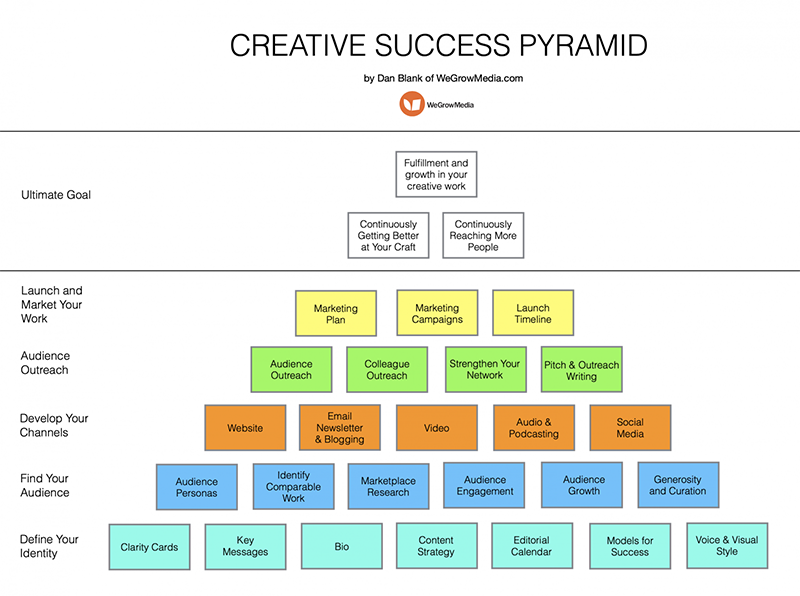
All of this is work I do as part of moving through what I call The Creative Success Pyramid (click the image to see a high resolution version):


If you want to explore collaborating on this work for yourself, you can learn more about how I work with writers here.

Thanks.

-Dan

How you share should be an immersive experience

So many writers are hoping to engage readers, and in doing so, they look to social media. For example, perhaps you’ve heard TikTok is leading to loads of sales of books, so you are either:

  1. Terrified to even look at TikTok.
  2. Exploring how you can become active on TikTok in the least socially embarrassing way.

I mean, sure, there are other options, but when I mention TikTok to most writers, there is a millisecond between me mentioning it, and them saying, “No way. Not now. Not ever.” So let’s consider: what is it about TikTok that is leading to book sales? I’m going to simplify it to this:

It creates an immersive experience.

That’s it. Through that immersion, readers give their attention, they hold their attention, and feel a compelling sense of connection. That’s immersion. Now, you may be thinking, “Dan, I am not doing dances on TikTok to sell books.” But I don’t think that is the immersion happening here. Instead, it is the immersion of emotion. These videos that are getting millions of views are capturing the excitement, heartbreak, and revelation that books provide. They also connect you to a like-minded reader like yourself, someone who loves being swept up by certain kinds of stories and books. Imagine if you moved to a small town, and walked into the local cafe, and there were a whole bunch of people who read exactly the kind of books you did, and they were always talking about them, and welcomed you into the conversation. That is how many readers feel about TikTok. That kind of immersion.

But today’s message is not about TikTok, per se.

Today, I want to explore what it means to create an immersive experience, and how you can apply that in wide variety of ways to how you share about your writing in a manner that feels authentic and accessible to you. Let’s dig in…

Simple Changes Can Create a Big Impact

This week, artist Claes Oldernburg passed away at age 93. I first became aware of his work at a Guggenheim exhibit in the 1990s. When you entered the building, you saw these massive sculptures, which felt much bigger in person that this image conveys:


What are they? Stuck halfway up the building is a ridiculously oversized shuttlecock, the thing you hit back and forth in the game of badminton. The sculpture on the right is a tank that has had its weapon replaced with a tube of lipstick. The scale of the work made you rethink everyday objects in compelling ways. I mean, just imagine the size of the person who would hit a 3 story tall shuttlecock. Or a tank arriving on the scene, and instead of firing a gun, extending lipstick to paint something colorful. A closer photo:


His work was immersive to me, drawing me in with the absurd manner in which he looked at the world. Of course, the Guggenheim itself is immersive, a space that allows you to casually walk down the sides as you look at art in front of you, but also seeing all the other art in a distance. The movement creates a unique experience of art that no other museum matches.


For much of Claes Olderburg’s art, he used two methods that illustrate how simple the path to immersion can be:

  • Material.
  • Size.

By simply changing the material you use, or the scale of what you are creating, something deeply compelling can be created.

For how each of us shares our own work, this same thing applies. So much of social media is filled with people copying “best practices” with the hopes of going viral. But what if instead of focusing on breadth, you focused on depth? Where you weren’t counting how many people, but instead, how deep the connection?

Immersion is a Choice

Creating an immersive experience doesn’t just happen, it is a choice. You’ve likely experienced this difference at a concert. The band who are doing everything they can to help the crowd get into the music, vs the band that just stands in the same spot for the entire show, with the same facial expression. The Rolling Stones just celebrated their 60th anniversary, and I’ve been watching videos of their recent live shows in Europe. Mick Jagger turns 79 this week, and It is just ridiculous how much he does to engage his audience. Go watch the entire 2 hour concert from July 11th. Or the entire 2 hour concert from June 16th.

Many writers hope that others will bring the immersion. That if they share a Tweet, that their followers will take all the initiative to reshare it, to comment on it, to like it. But when I study those who are great at creating immersive experiences, I find that they are working overtime to help others feel seen, to feel included, to feel engaged.

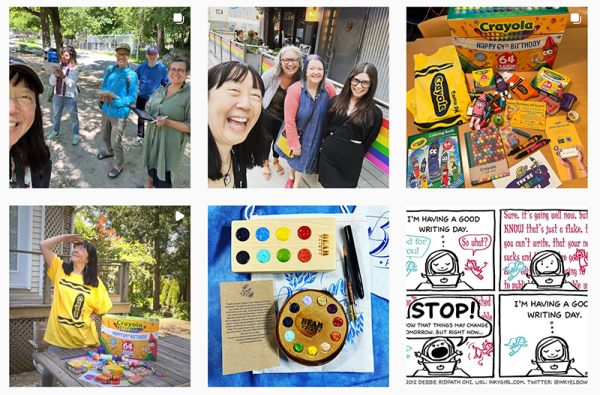
Look at how Debbie Ridpath Ohi does it in her Instagram feed:


Or how Jarrett Lerner does it in his Twitter feed. Or Susan Orlean.

The immersion you create is a choice. It signals to people not only what you care about, but how to connect to something deeper. This is not a “thing,” it is a process. And often, it involves the simple act of focusing on the people you hope to connect with, not a thing that you want to share. That is a small mindset shift, but an important one. One that says “I see you,” not “look at this.”

Immersion Requires Limits

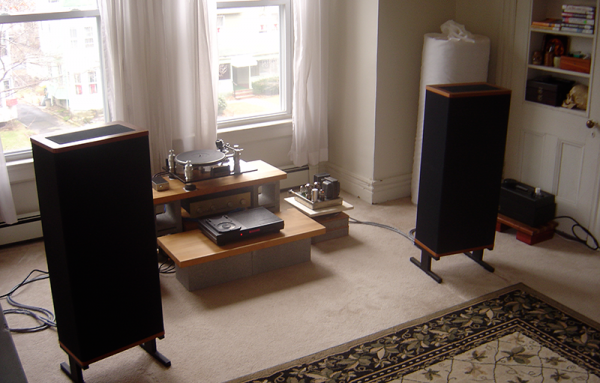
I recently wrote about how great art and writing are almost always created with great limits. For example: a ridiculous deadline, lack of essential material, and other boundaries that force the creator to find novel solutions. For how you share, immersing people benefits from limits as well. Years ago, before I had kids, I had a listening room in my apartment. This is a room entirely dedicated to listening to music. Here is one half of the room, with the stereo and speakers:


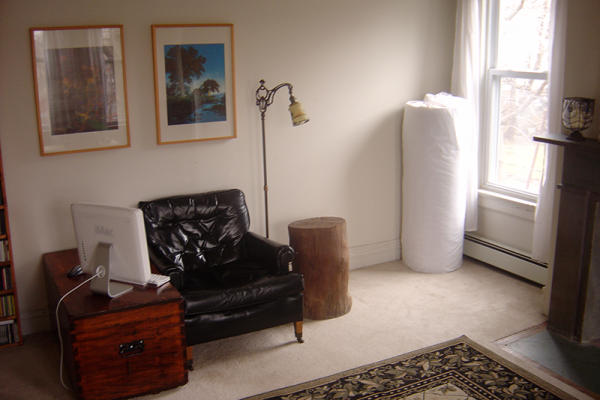
And here is the other side with my single chair:


At the time, my wife had her own single-use room, her art studio. When I listened to music, I wouldn’t multi-task. I would sit there, eyes closed, and just listen. It was wonderful, and fully immersive, like an isolation chamber. This decision requires severe limits: no television in the room. No couch or other furniture that would add different uses to the room. The entire room was about clarity of a singular purpose.

If you want to immerse people with how you share, I would encourage you to focus on embracing limits. To go narrow in scope, but go deep on emotion and connection. Yes, this requires commitment. To know that the themes you write about matter to others as well, and find a way to connect those two things. Immersion is not about trends, it is about focus.

How can you create and immersive experience in how you share?

Thanks.

-Dan

Anxiety and Sharing (Podcast)

Today I want to talk about the anxiety we feel when we share. So much of the work that I do is to help writers feel a sense of purpose and strategy in sharing their books, their writing, and their mission. But there are often hidden emotions and psychology which stops us from sharing, delays us from sharing, and makes us feel bad about sharing. That’s not good. I believe sharing helps your writing and art change people’s lives for the better. So I want to address the anxiety head on, because anxiety tends to thrive in silence.

You can listen to the podcast by clicking ‘play’ below, or in the following places:

You can watch the episode here:

Rejection is a normal part of the creative journey

Rejection is a normal part of the creative journey
Author Fleur Bradley shared this recently: “I would say I have at least 1,000 rejections, though I stopped counting long ago.” Today I want to talk about why rejection is a common part of the creative journey, and how that should empower you to choose your own path. I’ll also talk about the nature of compromise as it relates to our art! 

You can listen to the podcast by clicking ‘play’ below, or in the following places:

You can watch the episode here: