So many writers strive to get more followers for their writing. Today I want to discuss how to design an experience for how you engage with your readers, and develop your author platform. One that is thoughtful, focuses on engagement, and helps you view your platform as a craft, not an obligation.
Too often, when we think of developing an author platform, we think of the “content” we share. We post a piece of content, then check back to see how many “likes” it received. Instead, I want to encourage you to consider how you develop a full experience for people.
What does that mean? To create a platform that is deeply meaningful and posed for growth, which includes:
- Considering your ideal reader with a sense of total clarity.
- Crafting an experience that leads to engagement, not just hoping for hollow metrics of ‘likes’ and ‘follows.’
- Focusing on moments of connection that develops a true community around what you create.
I’ve sent out this newsletter every single week for more than 15 years. Right now I’m going to ask that you trust me as I share a metaphor for how to consider crafting your audience. I’m going somewhere useful with this, I promise…
So my friend, author/illustrator Lori Richmond, is renovating her home, and she and her husband have paid particularly attention to (please bear with me here) their cat’s litter box. I will say this up front: all of us should strive to create anything in life as thoughtful as she and her husband have designed the cat’s litter box.
Sound bonkers? It’s actually kind of inspiring. Here’s why…
You see, Lori and her family of 4 have shoved themselves into a tiny 1-bedroom apartment for half of a year, while their home is going through a gut renovation. In the process, they wanted to solve for every inconvenience they previously experienced living in Brooklyn, one being the cat’s litter box in their kids’ bathroom.
The solution? Okay, let’s take a look. This is their new kitchen, looking toward the pantry. See the little hole in the corner? That is the entrance to the litter box.

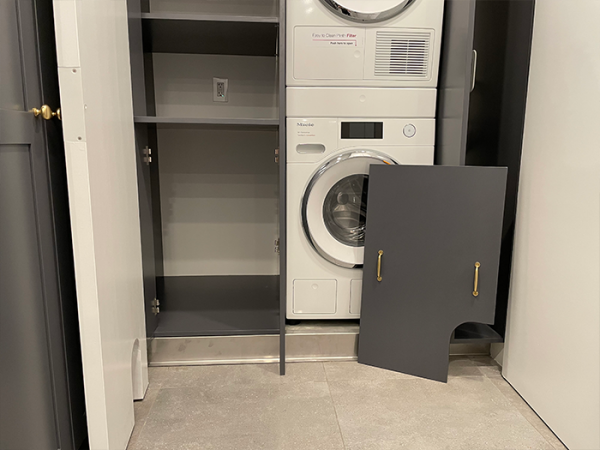
Here it is with the outside door open. Notice how the first hole is toward the left, and the inside hole is on the right:
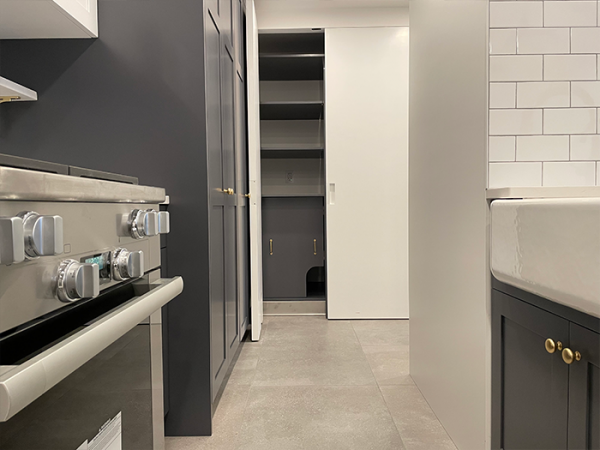
So once the cat, whose name is Mona, enters, she follows this little path from the first hole, to the second inner hole, where the litter box resides behind the gray door.
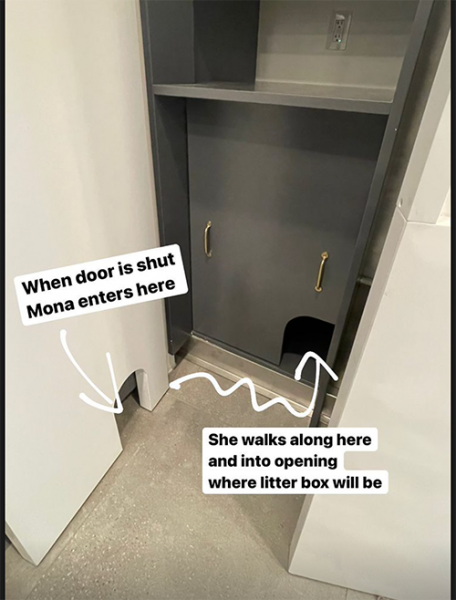
The two handles above it remove a panel that gives Lori and her husband access to clean the litter box, which will be placed in here:
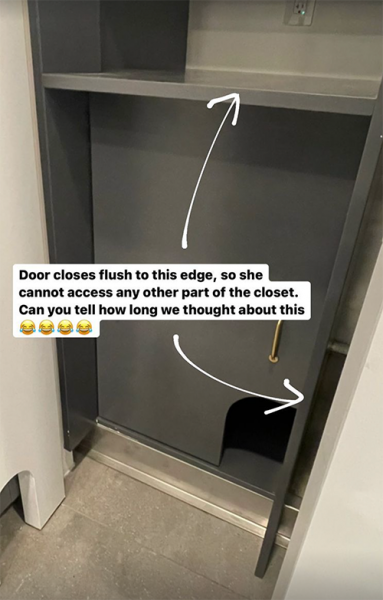
You will notice that the shelf above extends all the way to the door, preventing the cat from jumping up onto other shelves:
What’s that you say? It seems dark in there? Well, don’t worry, there will be a motion activated light to ensure Mona can see what she is doing.
So how is this litter box a metaphor for the experience you create for readers? Soooooo many ways! Let’s consider it:
Lesson #1 Consider How Readers Become Aware of Your Work and Enter Your Community
Lori and her husband found what looks to be a very elegant solution the challenge of integrating a tiny cat bathroom into their beautiful home. When you consider how someone discovers your work, the same thing applies. If you are on social media shouting about your book, and otherwise not engaging, that is likely not the best way to give people a path to your work.
In my book, Be the Gateway, I use the idea of a gateway as a metaphor. This threshold that you cross to move out into the world to find your ideal readers, then to walk them back through the gateway to experience your work. It is a process of communication and trust.
You have to carefully consider the language, context, and images that will get someone’s attention. How you get their attention in a manner that is meaningful, in an otherwise noisy world. It’s not always logical either, where you simply make a clear pitch for your book. This is what social media has taught us, which reflects real-life: what engages us can touch a wide range of emotions. Consider: how are you creating an entrance to your work that speaks to your ideal reader in an immediate and visceral way?
Lesson #2 Ensure People Feel Safe
There is a real empathy that went into how Mona can feel safe. The goal is for her to be able to use the litter box without being disrupted by the activities of a busy family. The corner entrance, the dual doors, the lighting, all of this is about helping Mona feel safe.
However you share what you create, be mindful of how others feel seen, and feel safe. Trust is such a critical part of what it means to have an author platform. Of course, your own sense of safety is paramount as well. How each of us defines that may be different, but it is something to consider at every step of how you share.
Lesson #3 Give People a Clear Progression
Where are you leading people? Let’s say you wrote a historical novel. Are you sharing 15 posts about flowers on Instagram for every one post about a theme of historical fiction? If that’s the case, you can’t be surprised if you aren’t gaining followers who love the themes you explore in your writing. So you have to consider where you are leading people, and how obvious that progression is.
Likewise, you may want to consider if you are offering people a million off ramps away from how you want them to see you and your work. What is the entire sequence of how someone discovers your work, learns more about it, stays engaged, and feels a connection to your work that can last?
Likewise, consider where points of confusion may be. Is your platform too vague? Do you rarely talk about major themes? All of this is a craft that takes time to get right.
Are you unintentionally doing things that allow people to wander away from what you create? Sometimes that could have to do with frequency of how often you share, or giving them so many links, they can’t follow them all. Much like Lori and her husband designed the higher shelf above the litter box so that the cat can’t jump up there, consider the holes in your platform.
Lesson #4 Consider the Goals of your Reader
Let’s face it, where the cat’s litter box is, is not usually the biggest priority for a human. But for a cat, it’s a big deal. I’ve had many veterinarians explain to me the delicate balance you want to strike with placement.
When trying to engage readers, you have to consider their goals, not just your own. What would they love to engage with? What kind of community are they looking for? What is their reason for loving a certain kind of story or topic? What would their dream experience be with the topic or theme from a book? These are all ways to consider developing what you share that aligns to the experience you develop for someone else, not just how you share “content.”
This will require challenging your own assumptions, and even testing new ideas. When Lori and her husband designed the entrance to the litter box, at one point they mocked it all up, printing a black entrance hole onto a sheet of paper, then taping that to the bottom of the door. Don’t be afraid to play with new ideas as you consider how to develop your audience.
Lesson #5 Collaboration is a Critical Part of Success
If your goal is to develop a community around what you create, the surest way to failure is to try to do everything alone: to have no colleagues, to eschew the idea of engagement with readers, to just hope that someone else shares your work. Be open to your author platform being social. One way to do that is to have collaborators.
Let’s consider the key collaborators involved in Mona’s litter box:
- Lori and her husband: Lori is a designer (plus author and illustrator), and her husband is a designer and educator who has incredible technical skills too.
- Their architect: who helped with the overall design of the litter box area.
- Their carpenter. Lori said: “Carpenters are true artists and masters of functionality! Our carpenter helped us tweak the design at the work site before he built everything. He brought up little details we wouldn’t have thought of.”
- Their plumbers: who had to redo work twice to ensure that every pipe around the litter box area didn’t infringe on the design and functionality of it.
Here is a photo of the contractor, Lori’s husband, and the plumber discussing the litter box during construction:
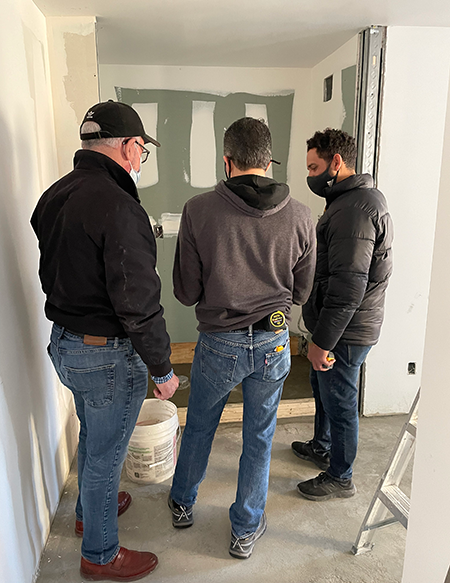
I mean, the cost of this is impossible to calculate. Not just in material, but the design prowess and expertise of 5 highly trained people.
How can you have collaborators in what you create? Recently I shared a post talking about the power of outreach, including gratitude emails. At the most basic level, simply consider: who else writes about the kinds of topics or themes you do? Maybe just send them an email expressing appreciation for their work. It can start that simply.
How you share and how you engage is a craft. Give yourself time to develop these skills so that they expand the possibility of what your writing creates in the world. If you want assistance in creating any of this for yourself, learn more about how I work with writers and creators here.
Thanks.
-Dan

 I’m so excited to welcome author Mary Laura Philpott onto the podcast. We discuss how she developed her career as a writer, transitioned from a traditional job office job to freelance work, and how she got her first big bylines in major publications. She tells the amazing story of how a sharing on social media lead to her first book deal, and how she got her agent. We also discuss her new book, Bomb Shelter: Love, Time, and Other Explosives.