My 5-part System for Conducting Marketplace Research (Podcast)

Today I want to share my 5-part system for how you can conduct marketplace research, learning how readers share and talk about books online. This framework can be applied to any kind of creative work. This is a critical process for understanding word-of-mouth marketing, which drives book sales. We will use TikTok as an example, though this methodology applies more broadly to channels such as Instagram, podcasts, and so on.

You can listen to the podcast by clicking ‘play’ below, or in the following places:

You can watch the podcast here:

My 5-part system for conducting marketplace research

Today I want to share my 5-part system for how you can conduct marketplace research, learning how readers share and talk about books online. This is a critical process for understanding word-of-mouth marketing, which drives book sales. We will use TikTok as an example, though this methodology applies more broadly to channels such as Instagram, podcasts, and so on. In case you haven’t heard, TikTok is a thriving social media platform, and there are many people on there talking about books. Sometimes this subgroup is referred to as “BookTok.”

What I hope to share here is a way of seeing and understanding marketing. To learn about the marketplace that you hope to share your writing in, how it works, why it is a powerful driver of sharing books, and even how you can directly engage with others. This is an example of the process I help writers with in my 1-on-1 consulting, when we dive deep into helping someone develop their platform, create an effective marketings strategy, launch their books, and find a sense of fulfillment in the process.

One thing to note here is that this process focuses on what I would call primary research. Meaning, you aren’t just reading articles about TikTok and forming an opinion based on that. Instead you are observing and participating yourself, which I think this is critically important. To be an active participant to truly learn about what is happening in an area of the market. When you read “best practices,” you are removed from the community itself. I know everyone wants a shortcut, but the difference is stark. If you want to understand the marketplace, get active in it.

What I share here is my process for diving into marketplace research from scratch. Okay, let’s dig in…

Step #1: Find a Way In

The first step is to simply allow yourself to experience the ecosystem. In this example, it would be to figure out how to see what people share on TikTok. This begins with simple steps:

  1. Create an account. You can do this through your computer by simply going to the TikTok website, or by downloading the app on your phone and creating an account there.
  2. I would recommend downloading the app to your phone either way because it allows you to see the full scope of tools TikTok offers. But if you aren’t ready for that, I believe you can get started on your computer alone.

I prefer to do this research through my computer and web browser because it’s a bigger interface. I use a 27″ monitor, compared to a tiny smartphone screen.

Once you set up your account, you are likely now staring at some viral video that TikTok is showing to you. Go to the search box and simply type in: booktok

Booktok is a hashtag that people who share about books will often include in their posts. So this is a great way to filter out anything that isn’t a post about books, reading, or writing. There are other searches you can do as well, such as ‘authortok,’ but you don’t have to worry about that yet.

Step #2 Observe and Listen

View some of the videos that come up in this search. Keep scrolling and loading more. Don’t try to look for certain kinds of books, just casually observe different videos. Get a sense for what “normal” is on this platform. For instance, that there is vertically oriented video, that there is often music that is key to how the message is presented, how long the videos are, that you may see likes/comments/shares to the side, etc.

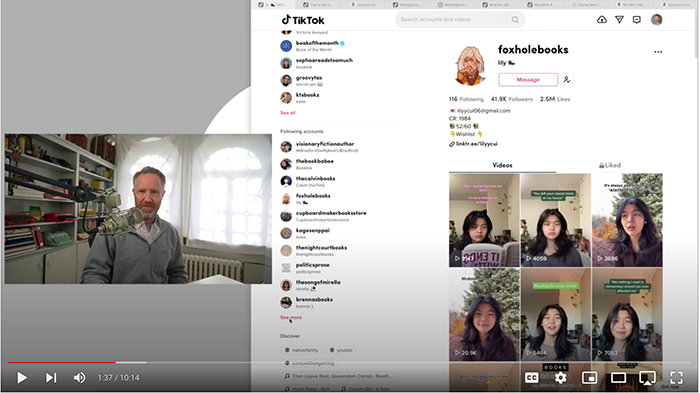
Want to know what this looks like? Here is a 10 minute video where I narrate what I observe as I look at some people sharing about books on TikTok:


Step #3 Celebrate and Engage

Find safe easy ways to interact so that you understand the sense of community that can happen here. Oftentimes, that is as simple as clicking the little heart icon next to a video. You can share a short message via a comment. Unsure of what to say? Share an emoji.

From here, consider following some people who share videos that you find interesting. If possible, follow a wide range of people who talk about different kinds of books, or have different styles.

For a week or so, do this for 5 to 10 minutes each day. Put all your assumptions on hold, and just observe and engage.

Step #4 Analyze

Analyze what individuals are doing in their videos. Not just “they are sharing about a book,” but note the details. For instance:

  • What is the topic or focus of a certain video? A single book? A best of list?
  • Note where the video has edits.
  • Note how many different elements are cut together. Are they using emojis or clip art or taking video from multiple sources?
  • What kind of music are they using, and how is it integrated into the message?
  • Is the person being on camera or not?
  • How is the shot framed? Is it close to the person or far away? Is it a close up of a book on a table, or a much larger bookself?
  • What are the different ways they feature a book itself? EG: the cover vs inside pages vs the spine.
  • How did they light the video?
  • Is there movement in the video? What is it exactly?
  • Do they put text on screen?
  • Is the video trying to be funny?
  • How frequently do they share a new post?
  • What does the person write in the text area of the video?
  • Do they use hashtags? Which ones?
  • How are others reacting in the comments?
  • What do they share in their profile (you may have to click to see this.)
  • What link do they share in their profile, and what is there when you click it? Are they active on other social media too?

In this process you begin to understand common things people do, as well as your own preferences for what you like seeing.

Step #5 Strategize

So far, you have had to share nothing on TikTok. Again, all of this work so far is about understanding the marketplace. You don’t need to know yet how to effectively use TikTok, where all the buttons are, etc. But consider these questions:

  • Why are these people doing this? Why are they sharing books on TikTok?
  • Does it feel effective? Are people reacting in the comments? Does it have a lot of views? Why do you think that is?
  • How would this help a writer connect with readers?
  • Do you feel your ideal readers may be here? If not, could they be soon?
  • What are other ways you can explore TikTok to find different kinds of authors or creators?

Then decide if you will go into observation mode for a period of time: a month, a quarter, a half year. Just keep slowly observing and learning.

Also consider if this is something you want to try out for yourself, sharing your own video on TikTok. Getting involved is a great way to demystify something and feel a part of it.

If you decide to not take any actions now, that’s fine. I realize that for many writers, they may not want to create videos on TikTok, or may feel that their ideal readers aren’t on that platform yet. But identify one to three places you will put your energy into instead. If you decide to ignore TikTok (or any channel), what will you do instead to engage with readers? Will you email five more people each week? Will you share more on a different channel? Will you try to meet more book clubs? Will you go to more bookstore events?

The key here is to find some way to engage with readers that feels meaningful to you. And of course, if you want help with this, consider working with me.

Thanks!
-Dan

My Process for Intentional Creative Growth

I spend the last few months of every year reassessing what I create, and how I can better serve writers and creators. Every single year, I go back to the well to reconnect with my deeper purpose for this work. My goal is to help people share their creative work in a meaningful way, one that leads to fulfillment and success. Today I talk about that process and ask for your help.

You can access the questionnaire I mention in this episode here.

You can listen to the podcast by clicking ‘play’ below, or in the following places:

You can watch the podcast here:

I could use your help

I spend the last few months of every year reassessing what I create, and how I can better serve writers and creators. Every single year, I go back to the well to reconnect with my deeper purpose for this work. My goal is to help people share their creative work in a meaningful way, one that leads to fulfillment and success.

I can use your help. Could you take a couple minutes and answer these questions:

  • What is your biggest challenge when it comes to how you share or market your work?
  • What are your goals for your creative work?
  • What do you create? What kind of writing or art?
  • What milestone do you hope to reach next as it comes to sharing/marketing?
  • Are there specific channels or tactics you want help with more than others? (E.G: newsletters, TikTok, podcast outreach, etc)

You can answer these questions by filling out this questionnaire. Your answers will directly effect what resources I offer to help writers and creators like you better share their work.

I have the pleasure of talking with writers every day, and diving deep into the work of creating and sharing. I’ve done this kind of reassessment the last quarter of each year for a long time, about a decade. I’m always trying to get more clarity the goals and challenges of writers and creators. To me, this work has to be intentional. I do this because I want to grow as a creator and someone who serves writers and creators.

I’m 48 years old, and I want each year to be filled with personal growth. To challenge myself in new ways. To keep what works, and ditch what doesn’t. I want to come home to my family from my studio feeling alive because my days are filled with inspiring writers who are finding success in connecting with readers. I want to feel challenged by the creative process. Each year, I want to feel that this year is not like the last.

For my own process of assessment, I’ve followed the same system for years. It’s a three part program that I used to teach in my (no defunct) Mastermind group where I collect all of my learnings and ideas, organize them, then strategize. Right now I am analyzing my current system of how to help writers best share their work, stress testing each component, and identifying any gaps I can find. My goal is to simplify so that everything I offer to directly addresses what writers need in an immediate and powerful way. I want to focus on results that will truly move writers towards their goals and solve their biggest challenges.

In my book Be the Gateway, I talk about a similar process of spending time listening to your ideal reader. I am doubling down on that myself because my goal is to be of the best service possible writers.

If you have a moment, it would mean a lot to me if you would answer the questions at the top of this note by filling out this questionnaire.

Thanks!
-Dan

Talk with readers

I want to encourage you to talk with readers. Not just because people who read are awesome, but because understanding reader behavior is a critical part of learning how to best market your writing or creative work. So many people wait until they are at the cusp of launching their book to do this, but the reality is that effective marketing takes time. Give yourself that time.

It’s easy to justify that if you wait to talk with readers and develop your platform that you will be better prepared. I’ve heard people say variations of this many times: “Why talk to readers or develop my platform before my book is finished, or before it can be preordered? That’s just silly. Let me wait until the book is ready, and then I’ll explore all of this.”

Often that means it will be too late to pursue a meaningful and authentic way to develop a connection to your ideal audience. You are locked into a very short timeline to publish and share your book, meaning the very first thing they hear from you is a version of: “Hello! Please buy my book. Oh, then review it. And maybe then tell a friend about it. And can you also come to this event I’m doing? Oh, maybe can you buy a copy as a gift too?”

Too many authors put off talking to readers because they fear becoming ‘that’ author over-promoting their book. But the more time you give yourself to talk with readers and learn about them, the less likely you will ever be perceived as someone who only shows up when you have something to sell. The more you learn about reader behavior, the more experiences you have around how books are shared, the more people you know who appreciate books, the more you are creating the precious resources required for good marketing: trust and communication.

Talk with readers. How do you find them? They are all around you. Simply ask people that you meet what they like to read. Then, be really curious.

Don’t just seek out people who read books like those you write. You aren’t talking to them to garner interest in your work, instead you are trying to better understand why they read, how they find books, where those conversations begin and where they go.

You are a student of writing as you develop your craft. I want to encourage you to also become a student of reading and how books are experienced and shared. The goal is to demystify reader behavior. Critical here is to expand your discussions outside of your immediate circle of friends and family. This may challenge every assumption you have about marketing, about book launches, about “the industry,” and about how to get people to pay attention to your work.

How to go about this? Well, it’s pretty simple: ask anyone you meet what they like to read. Then ask why. Truly be curious about what they read and why. Ask follow up questions that help you understand their behavior around reading. Don’t try to get them to become aware of your work, or validate it.

That’s it.

I remember seeing this in action years ago when I spent time with Barbara Vey, who at the time was a contributing editor for Publishers Weekly. I took her on her first subway ride in New York City, and on a crowded car she did something unexpected: she turned to the woman sitting next to her and asked her what she was reading. Barbara and the woman had a lovely conversation around what she was reading.

Barbara would tell me stories like this all the time. If she had to go into a medical facility, she would later tell me what her nurses and doctor liked to read. If she went to get a sandwich before we talked on the phone, she would tell me what the person behind the counter liked to read.

When you talk with readers, you dive deep into the “messy” side of the publishing world. You learn that readers don’t neatly fit into a box of only reading one genre, or reading regularly, or liking what you would expect they would. When you learn how to talk with readers, you learn so much about how books are shared, but also you develop a this capacity in yourself. Because when you launch your books, you will want to have the ability to casually talk about it in a way that will truly engage someone.

Your creative work will exist in an ecosystem. Understanding how real people engage with art similar to yours gives you a practical look at the reality of what the marketplace looks like. Not as a chart, not as a statistic, but in an everyday conversation with a real human being.

In my book, Be the Gateway, I explore this idea. It uses the metaphor of you creating a “gateway” to your work. But once it is built, you don’t put up a neon sign in front, hoping people find it. Instead, you venture away from your gateway into the world, discovering where readers already are, who they are talking to, and how to navigate the maze of paths that explain how books are shared. Over time, as you understand and befriend readers, the path to your gateway develops. The entire process is filled with empathy and authentic connections, not trying to game an algorithm on Amazon or figure out the latest trend on TikTok.

To identify how to effectively market your work takes time. It is a craft just like one’s creative work

I saw an example of this recently. Rick Beato started a YouTube channel about music a couple years ago, and has skyrocketed to having more than 2.5 million subscribers. On his second channel, he talked about talking with an Uber driver recently about what she listened to. Rick is 59 and loves guitar rock of the 60s through the 90s. The driver was a woman in her late 20s. He asked, “Have you ever heard of Paul McCartney?” She hadn’t. The Beatles? Nope. Foo Fighters or Dave Grohl? No.

At this point, you may think, “Here is someone young who only likes modern music.” But that isn’t the case. What she was listening to on her iPhone was 90s music. She went on to explain how she doesn’t like contemporary music, because she doesn’t resonate with the lyrics. She said, “It feels like everything is made for TikTok. It’s all beats for people to dance to. I really like lyrics.”

In the video, Rick went on to consider what this meant for musicians. Even though Rick has very clear and strong opinions about the music he prefers, his channel is filled with him analyzing not just classic songs, but music on at the top of the charts today. Rick has been a professional music producer for decades and is a virtuoso musician, yet he talks your average music listener all the time, and in the process, he learns a lot.

Marketing is a craft. Becoming good at it is not a matter of just copying someone else’s “best practices.” Focus on what you write and why, and what people read and why. That will give you so much of what you need to understand how to develop a strategy to effectively share what you create.

Thanks!

-Dan