Imagine having 39,000 followers on Instagram, and then saying goodbye to it. Walking away from your profile and thousands of likes and dozens of comments you receive each day.
That is what one artist did this week.
Today I want to revisit the idea of whether you need to be on social media in order to develop your author platform, grow your readership, and have a career as a writer. I will discuss leaving social media, the dangers of social media, whether social media is saturated, and a discussion of what social media does well.
Let’s dig in…
Why Leave Social Media?
The artist I mentioned above is Kelly Rae Roberts. This was her post announcing the decision:
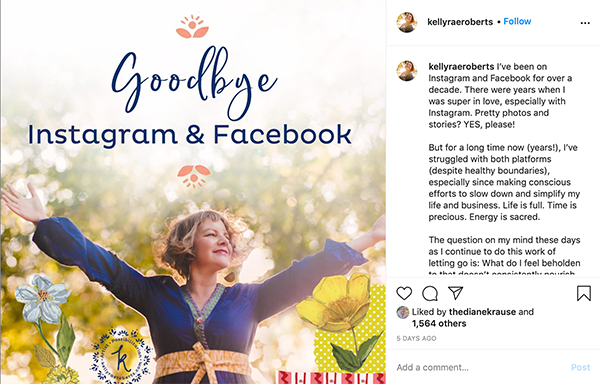
She calculated where her time would better be spent and concluded:
“Creating more deep down presence in my life. Creating more art. Creating energetic s p a c e. Creating psychic s p a c e. Creating more TRUST that I can do what I love (my art and my art biz) without feeling tethered to social media.”
This is one of the many aspects of being a writer or creator that I love: you get to choose your path. In what you create, how you create, how you publish, share, and connect.
Kelly Rae is making the decision that is inherently right for her.
But I also don’t rush to the conclusion that “social media isn’t necessary to develop one’s platform and grow a readership.”
Later in her announcement, she shared the ways that you can engage with her and her work outside of social media:
- MY BLOG! My intention is to show up in that space MUCH more.
- ART DATES WITH KELLY RAE: My monthly subscription which is loaded with videos and fun!
- MY NEWSLETTER: I send it out once a week, sometimes twice a week!
- IN PERSON RETREATS: When it’s safe to gather, I’ll be leading retreats again
- MARIGOLD & TRUE: My new little shoppe will continue its Instagram/Facebook presence
This is someone deeply committed to engaging with her audience. Each of these things are deeply social. She is not just giving up social media to focus 100% on creating art, she is going to be spending more time engaging in other connection points with readers.
Kelly Rae touches upon a trend that I wrote about a year ago, people returning to blogging.
What I see here is someone doubling-down on connecting with her audience. But doing so in ways that are more closely aligned not just to her own personal needs, but also to what better supports her business.
The five items listed above (blog, newsletter and services) may have fewer overall audience members, but I imagine these people are more likely to be fully engaged with her, and more likely to buy from her.
So that not only makes good business sense, I’ll bet it’s fulfilling too — to see people not just clicking “like” on a post, but engaging directly with your art and what you teach.
In marketing there is a concept called “the marketing funnel,” which is a metaphor for how someone goes from first learning about what you create to buying it, and then creating word-of-mouth marketing for it.
The items Kelly Rae listed above are all much further down the marketing funnel. Even though this may not be the reason she is leaving Instagram and Facebook, one outcome may be that by making these the only way to engage with her, she could create more customers for her work. Why? Her decision to not show up where you may expect — Instagram and Facebook — means that people may have to make a bigger commitment to be a part of the channels where she does.
So if you are reading this and jumping for joy saying “Ah ha! I knew it! I knew I didn’t have to bother with social media in order to build my author platform!”, then consider how else you will be able to connect with colleagues and readers.
Kelly Rae’s first post on Instagram was 2011. Since then she shared 6,231 images on her main feed, plus countless images/videos in Instagram Stories.She has spent years dedicated to building her audience.
Something I am seeing here is an artist evolving how she shares and connects. That is a process that began long ago, and will continue to evolve long into the future.
There is also value in making a bold statement as she is — a sudden abandonment of social media channels that you are known for gets a lot of attention. There are many comments on her announcement of how brave and authentic people feel this decision is, which reinforces why they follow her to begin with.
If she ever chooses to return to Instagram and Facebook, she would likely have a similar announcement that would re-engage her audience in new ways.
As I was looking at Kelly Rae’s feed this week, I wished I had more time to do a full case study about her career. Sadly, I don’t have that time right now. But I can say it was more than just a decision to be on social media or not.
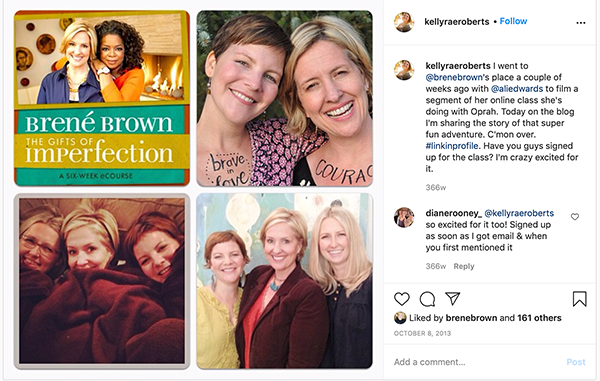
I saw a post like this one from 2013 where she was collaborating with Brené Brown and Oprah, and wondered what lead to it, and what happened from there:
After a lot of scrolling, I finally made it to the bottom of Kelly Rae’s Instagram feed, and found what I always do. Someone starting off with a tiny audience. Her first post from 2011 had 6 likes. Her 4th post had 2 likes. Her 6th post had 1 like. Day by day, year by year, she kept posting. Slowly, that audience developed.
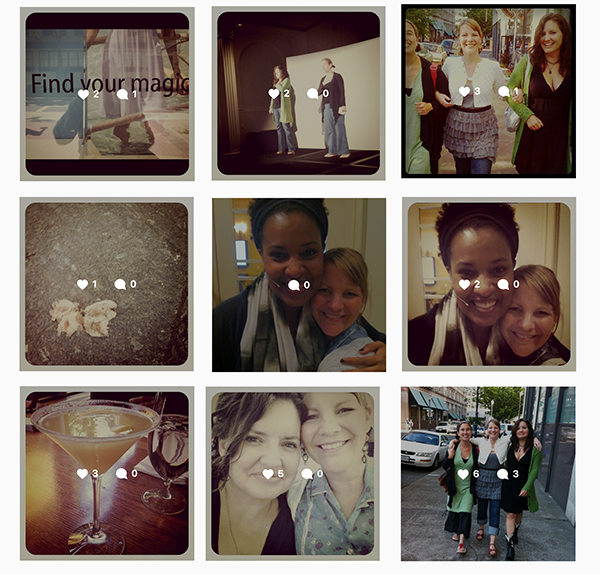
Kelly Rae put in the work. She shared often and deeply. To me, her pivot now away from social media to other channels is actually a new commitment on engaging with her audience.
The Social Dilemma
Lots of people have asked me recently if I saw the new documentary on Netflix called The Social Dilemma.
It featured interviews with technology insiders about the dangers of social media, mixed with dramatic recreations of how social media negatively affects our daily lives. It’s a compelling documentary, presenting the case for how social media manipulates us in ways that are exponentially more dangerous than anything that has come before.
It’s the type of documentary that can open your eyes to the bigger machine behind something that seems simple. I remember seeing documentaries about the food industry that had a similar effect.
I said this above, and I think it is worth repeating here. What I appreciate about social media is that we each get to choose if and how we engage with it.
Twice I have interviewed artist Marc Johns who doesn’t carry a smartphone. When I saw he joined Instagram and amassed 36,000 followers, I asked how he did that without a smartphone. He described how he bought an older iPod Touch and only connects it to wi-fi when he posts and image. It then gets shut down.
In other words, he has made an intentional choice about where he puts his creative energy. And only you can decide how to do that for yourself.
Is Social Media Saturated?
I recently recorded an interview as the guest on the podcast Fix Yourself with Shannon Connery, PhD. That episode is not yet published, but I wanted to share one item we discussed: is social media saturated?
I imagine she asked me this because it is easy for someone to feel overwhelmed by the firehose of content that comes out of our feeds. It’s easy to feel as though there are so many voices yelling for attention, that yours may not matter.
I shared two answers to her, both concluding that social media is not saturated. The first is that this is not a zero sum game. Just as in life, there is room for everyone’s voice. I think I gave an example of how, even though my small town has 5 pizza places, if a new one opened, it would still get adoring customers.
In some ways, every market could be considered “saturated” because there are so many options. But we each get to choose where we put our attention, and who we engage with. And in that manner, it can’t be saturated.
Just because there are billions of “friends” in the world, that doesn’t diminish the value that your best friend has in your life. I think the real question becomes, how do you use social media in a manner that is meaningful to you.
The second answer I gave her is that social media offers opportunities to people who may have few others. I talked about the young writer or artist who was just starting out, and perhaps felt misunderstood at home. Perhaps their family didn’t appreciate their art. Maybe no one else in their community did either. They felt they had no way to advance their craft or connect with like-minded creators where they live.
In that situation, social media offers an opportunity to feel understood. To create and share. To connect with people who share your appreciation for writing and art. As I said, this isn’t a zero sum game, there is room for every new voice. That always inspires me.
Do You Need Social Media? Nope.
Last year I wrote an essay asking if you truly needed social media in order to grow an online author platform? The easy answer was: no.
But I then outlined all of other options, and how much work they are. Social media is not the only answer for how to grow your platform and connect with readers. In 2017 I wrote a similar piece with different examples. You can read both of them here:
This week I had several conversations with people about what social media does well that are difficult — if not impossible — to recreate. Some of what we discussed is how social media provides:
- A sense of spontaneity. To be surprised by something you see, to find yourself engaged with it, to immediately comment back to the author, and share with a friend.
- A sense of authenticity of feeling as though you are in the moment with someone you follow, or sharing that for yourself. That is different in other channels: blogs, newsletters, online courses, and events where the content may be more pre-planned and published long after it was created.
- An easy way to share interests that reflect who you are in an informal manner. So much of what we share is what we experience each day, be it our pets, our home life, what we see, or what we feel. That often creates unexpected opportunities because one may never realize how much their cat can become a powerful part of their author platform. Also, many people are skeptical of marketing that always feels pre-planned. The informality of social media is why it has reshaped how much of marketing happens.
- An immediacy and scalability where something can quickly get engagement, immediately spread, and give you a real-time sense as to what engages people.
- Access to people would you otherwise not have. This works in terms of being able to engage with those who inspire you — perhaps that is well-known authors. But it also means that you can engage with readers, something that authors rarely had the chance to do before social media.
Nothing Happens if You Are on the Sidelines
I want to end with a powerful conversation that I had this week with author Elizabeth Bailey. We were discussing the connection between her previous career in film and as a music video director, with her current work as an author and patient advocate.
She had just finished reading my book, Be the Gateway, and was explaining how it helped demystify how she can live her mission as a writer and engage online. She explained it this way:
“The process is figuring out a life to lead, not a platform to have. You are not your author platform. You are only authentic if you are pursuing what is meaningful to you and making a difference to other people. Be the Gateway shows how this happens beyond your book itself.”
She went on:
“You have to start living your life to make something happen — you have to create. “
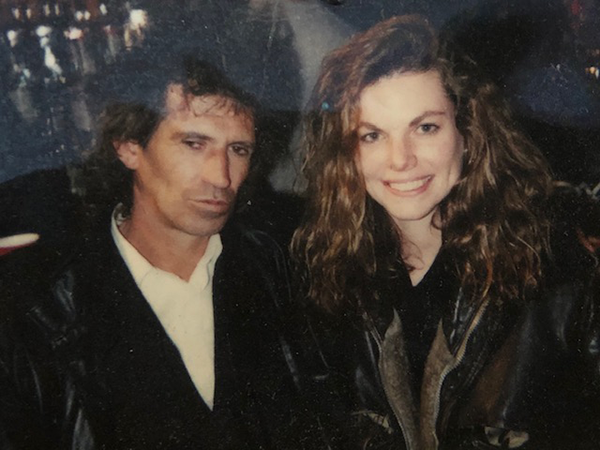
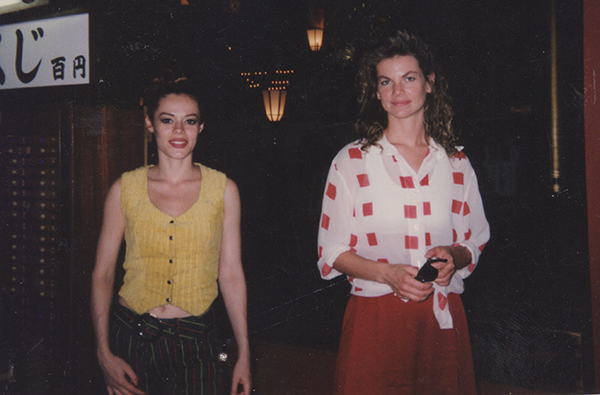
She talked about how this is what she used do in the 1980s and 1990s when she directed music videos. Here she is while working on a video for Keith Richards:
This is a photo of her with Lady Miss Kier when they were making the Deee-Lite video for “Groove is in the Heart.”
Here she is on a film set in New York City:
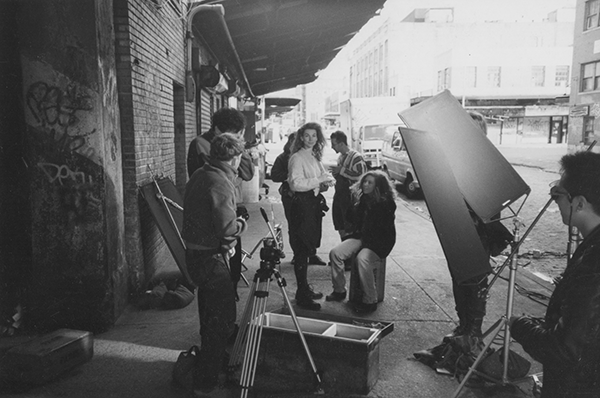
She described how the process of film was to be fully engaged. She said, “nothing happens if you are on the sidelines.”
Back then, the creative work happened in the streets. Today that happens online. It provides the immediacy of living in a similar way.
Whether or not you use social media — how you use social media — is entirely up to you. I simply want to encourage you to consider that question with intention. And if you choose to engage, consider how you can do so in ways that feel authentic to who you are, and can engage others in meaningful ways.
Thanks!
-Dan

 Gigi Pandian is a USA Today bestselling and Agatha Award-winning mystery author of 10 books. Today we explore the huge creative shift she made to stop pursuing a PhD in order to fill her life with more creativity develop her career as an author. She shares the long road to getting the first book published, how that book found a readership because of her active involvement in the community of readers and writers, and how that got her the book deals she hoped for for two of her series.
 For years, Valerie Bolling worked in education. One day, a visit from her nieces inspired her to write some stories. She set a goal to get published and “wrote and wrote and wrote.” Through a Twitter pitch, her book was acquired by a publisher. To find her agent, it took more than 150 queries (50 of which came after her deal for the book.) Valerie shares so much inspiring advice on creating and sharing.
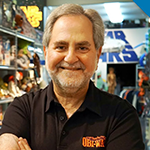 Today I want to share the story of an amazing creative shift. Steve Sansweet was working as a journalist when he was allowed to see an early screening of Star Wars in 1977. That day changed his life, and he went on to amass the world’s largest collection of Star Wars memorabilia. He eventually left journalism to work inside Lucasfilm, and today runs Rancho Obi-Wan, an interactive museum of Star Wars memorabilia. His story is incredible, and inspiring.