How can you create and share your writing amidst times of uncertainty? When more is asked of you than ever before. When you aren’t sure what tomorrow or the future brings. When you simply feel overwhelmed?
Last week I shared a case study on authors launching their books this spring, and how they are finding success, even as much of the world is shut down. So many writers I speak with struggle to find the capacity and margin in their lives to create. To even consider how they can share.
Today I want to explore possible options that may work for you, giving you a sense of momentum and fulfillment in not only creating what matters most to you, but sharing it with those who will appreciate it. Let’s dig in…
Oh, but first I want to say, it’s okay not to create and share. Your personal circumstances are unique to you. I know many people are working a full-time job from home, while now having to homeschool a few kids, prepare meals, and maintain a home that suddenly has 5+ people there 24hours a day. That’s a lot of dishes, laundry, garbage, and clean up.
You don’t have to create.
You don’t have to share.
Period. You can stop reading if you like. Zero guilt. Zero need for explanation. That is 100% your choice for what feels right for you.
But… (still reading?)
… what I do ask is that you make that choice for yourself. Regardless of which way you choose. Don’t just default to a vague justification of “Gosh, the world is so nuts right now, how can I create?” Or “I’m so busy, it’s overwhelming. Best to not create or share now.”
Be proactive in your choice here. Consider the cost of not creating and sharing.
If your dream is to finally finish that book you have been working on, there is a cost when you choose to delay working on it. I can’t tell you how many times people have told me “I can’t work on X now, I’ll have time in the Fall!” Then, three years later I hear from them that they are only now moving forward. “Time just got away from me.”
It’s tempting to think that one day, everything in our lives will magically just give you the space to create and share. That you will feel less pressure, less responsibility, have more time, more space, and maybe even more clarity and focus.
What I find in speaking with hundreds of successful writers and creators is that all of them make that time. They find ways to focus amidst a busy schedule.
How did they do it? Well, here are some ideas:
Take Tiny Frequent Steps
Most creative work is done slowly, in small increments, in less than ideal circumstances.
 When I interviewed author Stacy McAnulty, she explained how she started writing by giving herself permission to write. This was more than 15 years ago, when she wrote her first book one-handed, without punctuation or capitalization, because she wrote while breastfeeding her first child using her other hand.
Since then, she has written dozens of books, with 3 coming out this year, 3 last year, 6 the year before that, and 6 the year before that…
This is how she starts her bio:
“In no particular order… I’m a wife, mother of 3 kids and 3 dogs, author, daughter, sister and stepsister, aunt, friend, Twitter addict, mechanical engineer (currently inactive), inconsistent blogger, Packers fan, two-finger typist, concerned citizen, book-buying enthusiast, reluctant volunteer, minivan driver, pancake flipper, snooze-button hitter, and coupon clipper.”
A couple years ago, when I decided to finally learn how to play guitar, I gave myself a simple rule:
“I must practice each and every day for at least one minute.”
That is exactly what I did for a year. The one minute rule was meant to make it ridiculously easy for me to find success. There isn’t a single day where I couldn’t justify picking up the guitar and strumming a G chord for 60 seconds. Some days, that is honestly all I did.
After the first year, I upped that to a minimum of 1 hour of playing per day. This is what it looks like in chart form:
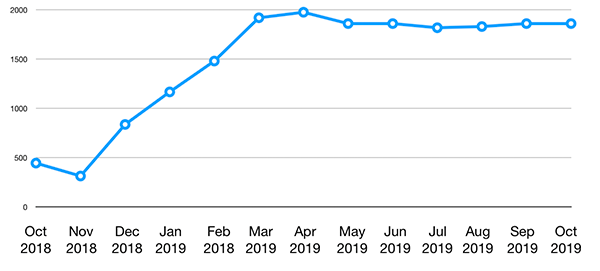
For your own work, consider what can be gained if you approached your creative work in tiny ways, frequently.
This applies to sharing as well as creating. I created a social media case study feating author Rachel Hollis earlier this year, that tried to showcase how she went from zero to 1.8 million followers on Instagram.
 Whenever I research someone successful online, I like to go back to see their first social media post. Why? Because I always find the same thing: they started as we all do: they worked for a long time with little recognition, and it took years to find an indication of “success.” Rachel’s first post on Instagram was August 25, 2012. Her early posts look like a lot of people’s posts do, everyday images with 10-30 Likes each:

It took her years to grow her following, day by day, after an astounding amount of work. She showed up each day and took tiny actions to create and share. The results? Her first book has 16,523 reviews on Amazon. Her second has 4,710.
If you look at what Rachel or Stacy have created in total, and think “I can’t do all of that, it’s too much,” I can assure you that they didn’t do it all at once. They woke up each day amidst a complex life, and took one action a day. Then the next. And the next. If you are unsure of how you can possibly find the time and focus to create and share, consider what is the smallest action you can take today to attend to it?
Ask Yourself, “What can I create?”
 This week I shared a podcast interview with author Jenny Blake. When everything shut down in March, her entire speaking and workshop business got “wiped out.” To find a plan through it, she asked herself a simple question: “What can I create?” In that process, she moved her weekly podcast to daily. Is that the perfect decision? Who knows. Jenny focused on what she can create right now, and is using creativity to invest in herself.
In our chat, we had an honest conversation not just about managing the strategy of having a creative career, but how to manage the emotions of it as well. So many people delay creating and sharing because they have too many ideas and don’t know which to pick. They delay and delay, vetting ideas, waiting for one to magically be proclaimed as “the perfect idea.”
Instead of waiting, why not just focus on what you can create and share now? This is how momentum begins.
If we think of dieting as a metaphor, this is akin to simply making a healthier choice tomorrow, instead of waiting months researching “the perfect diet.” Each day we have the choice to be 1% healthier. Likewise, we can take one action to create and share what matters to us.
Not Creating is Part of Creating
I am a huge believe in the power of rest. Sometimes the best way to infuse your life with creativity and sharing is by taking breaks. Some options:
- Sleep! Yes, sleep. Beautiful, magical sleep. I’m not someone who will ever tell you to “Wake up an hour earlier to fit your writing in.” I believe sleep is essential, and that if you feel stuck in your creativity, sometimes the answer is more rest.
- Naps. I’ve taken a nap every day for more than a decade. My 3 year old and 9 year old expect me to take a nap each day. The 3 year old gave up naps years ago. Daddy hasn’t. Why do I do it? Not because research studies show the incredible health benefits (though, they do), it’s because it gives me a creative reset in the middle of each day. If I lie down for even just 10 or 20 minutes, I get back up feeling refreshed.
- Take breaks. I schedule unstructured time into my day. Getting out of your normal routine and place of work can help you reset and be more likely to embrace creative ideas. This can be taking a walk in nature, or just getting out in the yard. It can even include listening to music and reading books.
Find Your Clarity
Author Rachel Davidson asked me this week: “What has been the one consistently successful tactic you have used to get yourself to your desk and being present every day?”
Some of how I do it includes the tactics above. But probably the biggest way I am able to create and share so often is because of clarity.
A decade ago, I sat down on the floor of my old apartment and took out a stack of index cards. The floors were crooked, and whoever installed the carpet in the living room did it wrong — there was this harsh ridge running diagonally across the floor. There I sat, on one side of the carpet ridge, and on each index card I wrote down a goal for my life.
After I had around 10 cards, I organized them into a pyramid where the single biggest goal was at the top. Since that time, I have turned this process into an exercise I call “Clarity Cards,” and I’ve had hundreds of writers go through it with me. This is what they look like:
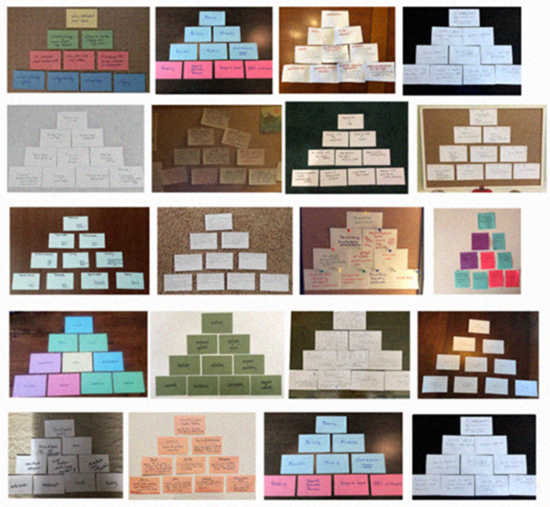
Finding clarity in what you create and why can give you that daily focus that is sometimes elusive. You can start by simply writing down why you create. Why it matters to you. Why you think it could brighten someone else’s day.
Then tape that to your bathroom mirror so you see it each day.
Do you have any questions about how you can find more time and energy to create and share? Email me and let me know. Happy to help.
Thanks!
-Dan

 When I first noticed author/illustrator Jarrett Lerner, he was using his Twitter account to constantly celebrate other authors and books. His generosity got him noticed. The result? 20,000+ followers. His first book was published in 2017, his second in 2019, and he has 9 more books in the works to be published within the next two years. In today’s conversation, I talk to Jarrett about what it means to live your mission as a writer, and what that daily work of creating and sharing looks like.
  A few months ago, I shared
  For our second case study, I want to
  This is something that
  How can you launch a book in a constantly changing world? Author Leigh Stein is finding out. She has been focusing on what she can control, remixing strategic plans, and devising new ideas filled with creativity and connection. We dig into it all in today’s conversation. This interview is part 2 of my book launch case study with Leigh as she prepares for the June 30 launch of her book: Self Care: A Novel.