“I rewrote that book for six years, and it never sold.” My interview with author Jessica Strawser

On the surface, one would think that Jessica Strawser was perfectly placed to easily become a novelist. She was the Editorial Director of Writer’s Digest magazine — someone who had incredible connections in the publishing world, and understood it inside and out.

But her reality is different than the fairy tale that we tell ourselves about how a writer succeeds.

Today, we are going to dig into her creative shift to becoming a full-time author. I can’t even express to you how excited I am to share my interview with her, it is filled with insights and inspiration that will help you on your own path in your writing life.

You can listen to the podcast by clicking ‘play’ below, or in the following places:


Here are some highlights from our conversation:

  • She describes her early days of attempting to write a novel: “I was the queen of having things that I started, and then would lose interest in them really quickly. I had so many false starts. I never stuck with it.”
  • She developed a serious writing habit once she was married, had a full-time job and kids. I loved her response when she was thinking back on her youth, “I think back on all those nights where it was just me, in my apartment, with a bottle of wine, and I squandered it. I would start half a chapter and then watch Allie McBeal reruns.”
  • What changed for her: “Wanting to be a writer is not the same thing as having a story that you want to tell. I don’t think I had a story that I felt compelled to tell”
  • On writing her first novel: “I rewrote that thing for six years, and it never sold. But I learned so much while I was doing that.”
  • To my surprise, she purposefully didn’t use any of her connections that she had through Writer’s Digest. In fact, she did the opposite! She hid her writing from everyone around her and purposefully submitted to agents that she did NOT know, instead of agents she did know. She described it as “a completely backwards approach.”
  • She spent half a year submitting it to agents, and when she got a ‘revise and resubmit’ request from one agent, this is what she did: “I opened up a brand new document and I rewrote the entire novel. I took about 9 months to do that. Then he signed me on the revision.”
  • She did sign with that agent. He started shopping it, “I slowly collected rejections on that novel for 18 months. While I collected those, I wrote another novel.” This is such a reminder of the sometimes glacial pace of a writing career.
  • When that book failed to sell, this is how she describes her situation: “I had two novels and no agent. I actually thought about stopping — taking a break. It was really exhausting. I thought, maybe I should put this dream on hold for awhile.”
  • When she signed with a new agent, they decided to not seek publication on Jessica’s first novel, and instead she went out with the second novel. “She sold it in less than two weeks in a pre-emp. It was the exact same manuscript that had been sitting on my hard drive for months while I tried to figure out what to do with it.”
  • Her story of when she received the news of her book getting sold is the embodiment of how complex it is to raise a family, work a full-time job, and have a writing career on the side. I asked her about the moment when she found out her book sold to a publisher. She says, “Do you want to know reality? My daughter was one, she had fallen and tripped the carpet at daycare, and knocked out one of her four teeth. I get this call from daycare that my daughter knocked out a tooth and is gushing blood. I flew out of work, frantically calling dentists. She was okay, but she was just going to not have a tooth in that spot for about 8 years. When I got home, I was cleaning blood out of shirt, and my agent called and said, “What did I catch ya doin?” She then told me we had an offer. It was one of those days that you are caught up in the disaster that is your every day life. [To celebrate], we were going mattress shopping that night, so we bought a king instead of a queen. That was our splurge. It was very glamorous.”
  • We talk about her experience in marketing promoting her books. “No one should underestimate the amount of attention and time that goes into marketing and publicity. It is a big undertaking and it is as much a part of the career as the actual writing is.”
  • She describes this time when she was publishing one book, writing another, and working a full-time job as: “I think I was existing on the smallest possible amount of sleep that anyone possibly could.”
  • When she left her full-time job to become a full-time author, it was not easy to shift her creative process from being an evening writer to a daytime writing. “It took me 6 hours to do what I used to do in 2 hours. I used to be able to use my day to prepare myself for those 2 hours that I was going to write after my kids were in bed. I would know what chapter I was going to work on, I would jot down notes, I would dictate to myself in my car on my commute. I would psyche myself up for it. I lost that [when I had all day to write.] I ended up clicking around on Facebook and the next thing you know, it’s lunchtime. I do have self-discipline, but I had to recalibrate, and there was a learning curve.”
  • Her advice for writers: “One of the things I would see so often at Writer’s Digest is that so many people just want someone to tell them the way, the steps to take, the path to follow to get it done. But it really is different for everyone. Even if you head down a wrong path for awhile, that is what needs to happen to get you to where you are trying to go. It’s smart to be aware of how other people find their way, and how it usually works, while at the same time, don’t get too get caught up in it. You can get distracted by what other people are doing and if you aren’t careful, you can spend the whole day feeling like you are doing it wrong. But there is no such thing as doing it wrong. If you just keep at it — persistence is huge. You have to be bullheaded about believing in yourself, while also being open-minded and flexible in how you get it done.

You can find Jessica in the following places:
jessicastrawser.com
Her books on Amazon
Twitter: @jessicastrawser
Facebook

Thankful

Every day, I work from a private studio. Here I collaborate with writers, work on my own writing, and obsess about the creative process.

Dan Blank

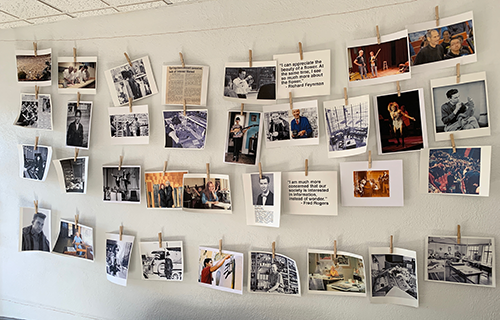
On the wall in front of me are photos of writers, artists and creators who inspires me:

I want to share the story behind four of those photos today.

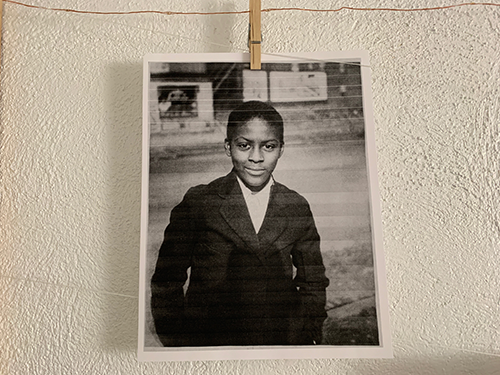
Here is a young Chuck Berry:

It can be said that rock n’ roll didn’t have a single “inventor” and you can trace back it’s origins to many different people. But if there is one person I would point to who truly represented the birth of rock ‘n roll, someone who was the first to define so many aspects of it, it would be Chuck Berry. When I look at a photo of young Chuck Berry, it is astounding to consider all of the things he will create. The music he will write. The way he will define a music, performance, and cultural style. It is a reminder that every child and every adult has this potential. Not just to succeed, but to create something that will turn the world on its head. Thank you Chuck Berry.

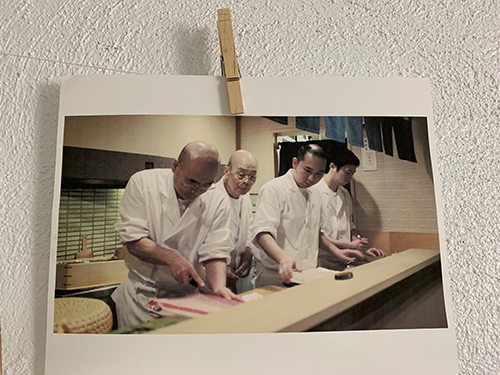
Here is Jiro Ono (second from left):

He is the sushi chef made famous in the documentary “Jiro Dreams of Sushi.” Today he is 93 years old, and likely still showing up to his restaurant and preparing sushi for his customers. Just has he has done for most of the last century. Think about that: he does the same thing today as he has done in 1987, 1968, 1951. His work is a reminder that the creative process is a practice. One you have to show up for each day. That the work only gets deeper the longer you do it. You don’t rise to some plateau, and then coast. You keep showing up. You keep honing your craft. You keep growing as a person. You keep delighting those who appreciate your work. Thank you Jiro.

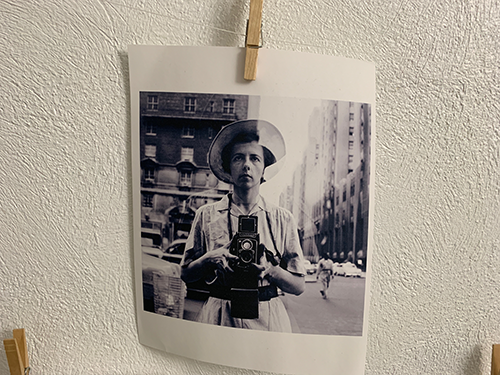
This is Vivian Maier:

She too was made famous in documentary, “Finding Vivian Maier.” She worked as a nanny from the 1950s through the 1990s. Why is she on my wall? Because during that time of caring for children, she often carried a camera with her. In her lifetime, she took more than 150,000 photos, most of them what we would now call “street photography.” She captured poignant images of people she saw in everyday life around Chicago. Today, it’s not hard to imagine taking 150,000 images with your phone. Each photo has no cost, and you can take a decent photo with your eyes closed. But Vivian took these images on film, on a camera that likely only shot 10 pictures per roll, while also caring for children and going about her daily work. Vivian teaches me that each of us — regardless of how the world sees us — can create work of captivating beauty using the most ordinary of tools. In our lifetimes, we can create a body of work that will inspire others for generations, even if we get no credit for it while living. Thank you Vivian.

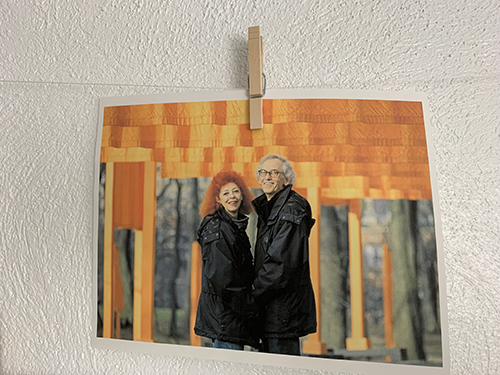
This is Jeanne-Claude and Christo:

They have created large scale works of art. I saw them speak in 2004 just before they opened a new work called “The Gates.” At the time, I was enamored with the artists, but skeptical of The Gates. Their idea was to line the paths of Central Park in Manhattan with 7,500 structures that you could walk through. These looked like awkward rectangles that had a piece of orange fabric hanging down from each. To me, it seemed like a strange idea to have spent so much time and money on. They began the project in 1979 and it took 25 years to convince the city to allow them to do it. A few months later when I was able to finally experience The Gates, I realized how mistaken I was. the experience they created was magical. I had walked through Central Park many times before, but this experience was wholly different. The Gates encouraged you to explore the park in new ways. I found myself pushing ahead to see how the landscape was changed because of these objects. But what jumped out at me even more was how The Gates changed human interaction. Normally in Central Park, you try not to get mugged. But when The Gates were there, everyone was happy. You met new people. You connected with strangers over art. It was incredible. Thank you Jeanne-Claude and Christo.

There are many other photos on the wall of my studio, and many more that need to be added. But I’m curious:

Who inspires you to create? Whose story helps you hone your creative process and push yourself ahead even amidst setbacks? Whose photos should hang on your wall?

Thanks.
-Dan

“I trained myself to write anytime, anywhere, in a split second.” My Interview With Author Elizabeth Spann Craig

Today I’m excited to share my interview with author Elizabeth Spann Craig. Okay, let’s get the impressive stats out of the way first:

  • She writes 3.5 books per year.
  • She has written 27 books since 2009.

She shares so much amazing advice about how she writes, manages her publishing career, and attends to her author platform. Some of what we cover:

  • How she abandoned earlier books she wrote because she hadn’t yet found her voice. She had just thrown away those manuscripts a few months ago.
  • How she wrote her first book while caring for a kindergartener and a baby (who didn’t like to nap) “I could get her to watch Elmo’s world, and I could fit in 15 minutes of writing. 15 minutes a day, I had a book in less than a year.”
  • How the first publisher she signed with closed shop before her book was published.
  • Over a three year period, she wrote another book and queried more than 100 agents. When she was rejected by all of them, she then broke the rules: she submitted the book directly to multiple publishers at once (without an agent.) Two publishers were interested and she signed with one.
  • After she signed with a publisher, Penguin reached out to her to congratulate her and say that they were going to give her an offer when they heard she had already signed with a different publisher. What she did next astounded me. Elizabeth wrote back and said, “Is there anything else you would like to have written? I can write anything.” The editor wrote back saying that she had a new series that she needed a writer for. She asked Elizabeth for 30 pages, which lead to a contract.
    She credits many collaborators who helped guide her along the way, including her agent and other writing mentors.
  • Elizabeth is honest about her process in a way I don’t often hear writers talk about: “I’m a commercial writer: I wrote for a market. I’m very deliberate about that. Fairly calculating. But it’s also a creative challenge, because I have these parameters that I have to work within.”
  • How did she find the time to write and publish 27 books in the past years? This is how: “I trained myself to write anytime, anywhere at a split second. I had notes on my phone, I had Google docs, I had stuff ready to go. I always started out waking up an hour before my family. So that meant 4:30am. I would get enough of my goal done in that hour where I felt already good about it. Then I wrote in both carpool lines, I did afternoon pickup. I would pull the seat all the way back, put the laptop between the steering wheel and myself, and type. I was usually in the carpool line about 45 minutes before school let out, you are on the street otherwise. I got the words done. If I was at a doctor’s appointment — no matter what it was — anytime I had dead time, like oil changes, I would pull it out and start working on it. Five minutes here, five minutes there. Also in five minutes, you can make your story progress by making a list of possible endings, plot or setting details, or just little lists that can go into your story later.
  • Her connection to readers: “The relationship I have with my readers is very tight. In terms of suggestions, complaints, I’m very responsive. I’ll write you back 20 minutes later if you email me.”
    Why she moved to self-publishing, “I was making more money self-publishing than I was from my two Penguin books. Money talks, so it was clear to me that I had to keep self-publishing.”
  • How she manages her author platform  and social media, and why she has written a blog for years, why she engages so actively in the online community with others writers. She said, “Honestly, I think that is the favorite part of my day.”
  • I asked how she stays on top of blog and trends, and she said, “I subscribe to 2,700 blogs.” She explains how she goes through this to create what she shares on social media.
    “Every day I’m writing is a good day.”


You can listen to the podcast by clicking ‘play’ below, or in the following places:

You can find Elizabeth in the following places:

Listen to Your Readers

A few weeks back I launched a program called The Reader Connection Project. This was meant to be a free 10-day course, where I walk writers through 5 actions they can take to immediately connect with readers.

Things didn’t go as planned.

I expected like 9 people to sign up for this. I figured I would spend the week with a handful of writers, and it would fun little collaboration.

But quickly there were 40, then 70, then 110, then 160, then 200 people who had registered. I was blown away.

Today I want to share the feedback of what these 200 writers learned in this project, and do so in a way that will be useful to you. I’m also going to share what I learned along the way.

This piece of feedback from a writer who participated is a good starting point:

“This has been a great project for me, helping me connect with readers and also helping me get over seriously bad self doubt. I can’t tell you how freeing this feels. And it wouldn’t have happened without the Reader Connection Project.”

Here are the top takeaways that writers got out of the program:

Go Deep, Not Wide

Most writers I know are tired of trying to get more followers. They are convinced that agents and publishers and readers want to see a big number of followers. The result? The writer exhausts themselves trying to game the system with tips and tricks and shortcuts.

What is the alternative? This feedback a writer shared:

“The Reader Connection Project reframed how I think about marketing: develop a deeper relationship with the reader, thereby building bridges of mutual interest and respect.”

Doesn’t that just feel better? And doesn’t it intuitively make sense? Social media is people, and no one wants to engage on some superficial level. They want depth.

When you decide to go deep instead of wide, suddenly social media makes sense. It becomes just like real life. No one runs around trying to shake as many hands as possible. Instead, they forge real connections with people, and sustain them slowly over time.

There, that’s your social media strategy.

Joining a Creative Community Creates Momentum

It can be soooooo lonely to not just write on your own, but to figure out platform and marketing as well. That isolation can create a lot of false narratives that you alone are failing, while everyone else is succeeding. That’s not true.

This piece of feedback really struck me:
“The biggest thing was realizing that so many authors are going through what I am going through. Struggling to find my readers, and finding the right way, for me, to help people discover my books. But this group has shown me that, like me, there are so many writers out there who dearly want to personally connect with their audience and really serve their readers. It restored my faith. And I’ve found all of you quite inspiring.”

That is why I work with writers, instead of shoving them into some course where they drown amidst 50 modules. A linchpin of this is the Creative Shift Mastermind that I run, because I have seen the profound difference that working with a small group of other writers can make.

It’s like a veil is lifted:

“These videos and the interaction with other writers is helping me understand my ideal readers much faster with a more balanced view. I can’t say how absolutely great it has been to connect with other writers in exactly the same place as me.”

If you are struggling alone with this work, find a collaborator, or a group of collaborators.

Listening Helps You Communicate More Effectively

Too many writers try to launch a “platform” before they have really spent time listening to readers. The result, their readers feel like some distant person and the writer is stuck posting random stuff, desperately trying to sell a book.

I loved this feedback:
“The Reader Connection Project showed me how my ideal reader might think – and how to really speak their language. I discovered some things I was quite mistaken about; some things I was half-doing.”

And this:
“This program helped me talk about my books and how I communicate with my readers.”

The internet has made the voice of the reader so much more accessible. You can more easily read reviews and hear how readers talk about books, but you also have the ability to reach out to readers and writers directly via online tools.

If you are primarily focused on getting ‘likes’ and ‘follows’, I want to encourage you to switch your mentality and consider, how can you reach out to one person and have a meaningful conversation around books?

Then consider: how can this help you better communicate what you write and why?

Readers are not Demographics, They are Complex

This was the heart of the project: understanding readers so you can better connect with them. Too often, writers describe their ideal readership in flat, wholly unhuman terms. They list out vague demographics, or a simplistic view of someone whose entire life seems to hinge on reading a single type of book.

Writers do this because the truth can be confusing: readers are complex.

But when you truly spend the time to talk to readers, and study how they talk about books, you find insights that others miss. Like this:

“The Reader Connection Project helped me identify two new kinds of readers for my books who I would have thought to try and reach.”

“The Reader Connection project gave me a glimpse into the heart and head of the reader.”

“The Reader Connection Project helped me delve into readers’ motivation for reading, that the answers are complex, that readers themselves don’t always know how to articulate.”

When I work with private clients, we often create personas to try to understand the core readers we hope to reach. But even when we do that, we describe them as holistic human beings, who have a wide range of preferences. I want to encourage you to view your readers in the same way.

There is No “Audience,” Only Individual People

The term “audience” creates a vision that you are speaking to a collection of people who are all the same. But whether you are sending a Tweet or publishing a book, each person reads it as an individual. What it means to them is personal. This perhaps sums it up best:

“The fundamental takeaway of The Reader Connection Project for me: Writing a book is about connecting with my fellow human beings”

Stop Copying What Other Writers Are Doing

Writers often study blogs, podcasts, webinars, and courses to identify “best practices” on how to develop their platform and market to their ideal audience. They do so because they want a shortcut — a hack — that allows them to identify what works and avoid what doesn’t.

That sounds smart, right?

The problem with it is that a writer in this situation is copying what thousands of others are copying, and it’s often a tactic that worked really well a few years ago, but has long since stopped providing good returns.

Do your own research. Talk to readers. Talk to writers. Develop your platform and marketing based on how you are and who you hope to connect with.

This feedback was welcome to hear:

“The powerful insight for me is that while most of the “best practice” advice is overwhelming, the idea of making human connections is very accessible. I can do that.”

“One thing your and this community you’ve built has taught me is to trust my instincts more.”

I want the aspects of your life that deal with platform and marketing to feel fulfilling. It’s difficult for that to happen when you are on a crowded hamster wheel chasing the next marketing trend.

Start Now, So You Don’t Panic Later

What I have found is that the sooner you begin this type of work — discovering the voice of the reader and connecting with them — the better you will feel when it is time to launch your book.

I have been through hundreds of book launches. I know that feeling when the book you have worked on for years is about to be published, and you simply want to do everything in your power to ensure it connects with readers.

Why wait until the last minute until you are in the “launch window” to do this work. When you view your readership as human beings, the nice thing is that it is easy to identify simple ways to connect with them right now.

Here are some good quotes that sum it up:

“The Reader Connection Project taught me that it’s both OK and necessary to connect with readers long before you have a book to sell. How to make connections with people one at a time and how to offer something of value to gain trust well ahead of sharing my novel and asking them to spend both their hard earned money and precious time.”

“Through your tutelage, Dan, I became a student of what people read, their motivations. Knowing this is so important as I anticipate my memoir launch next year.”

“Dan, you have a way of inspiring me to do stuff I have been putting off and of coming out of my shell for the sake of my art.”

I Learned So Much As Well…

The truth is, the Reader Connection Project taught me a lot as well. I tend to prefer deep collaborations with writers, and over the years I have honed the two ways to work with me into two programs:

  1. The Creative Shift Mastermind: a three month program where I work with groups of 10 writers at a time.
  2. One-on-One Consulting: where I become the copilot in helping a writer develop their platform, reach readers, and launch their books.

My experience in the past couple of weeks taught me that some writers want to work with me, but need a smaller commitment. That has given me a lot to consider as I prepare my programs for 2019.

Another thing I have learned is to consider how to amplify the message of a book. The real reason that I expected only 9 people to sign up for the Reader Connection Project? Because for the most part, each of the five steps are already covered in my book, Be the Gateway. I figured that this information had been “out there” for two years now.

But again and again, writers in the Reader Connection Project mentioned that they had read my book awhile ago, but only because of this project were they now taking action.

What was the difference between this project and reading the book? A few things:

  • Videos: As a core part of this project (and my Mastermind for that matter) is that I shared videos where I talk through details of each step. The feedback I received was that hearing the advice was so much more useful than just reading it.
  • Community: Working with a small group of other motivated writers is a world of difference than sitting alone in your house, and having to figure things out on your own.
  • Leadership: Again and again, people mentioned that they could really feel how much I cared about writers and readers when they watched my videos and went through the program. I think there is a big difference between seeing a series of tactics on a to-do list vs having someone truly guide you through them.

Everything I learned above is being infused in what I create in 2019. The first of which will be my next Creative Shift Mastermind program. If you want to be the first to know when I open the doors, please add your name to the early interest list here.

Thanks!
-Dan

The Essential Ingredients of a Writing Career: Hope and Perseverance, My Interview With Author Therese Walsh

I’m so excited to share my interview with author and editorial director of WriterUnboxed.com, Therese Walsh. In our chat, we dig into:

  • How she co-founded a blog that turned into a thriving online community for writers.
  • The realities of the book publishing business, and how to develop the right mindset to navigate it.
  • What she has learned from the writing community through years of engaging with thousands of writers.

You can listen to the podcast by clicking ‘play’ below, or in the following places:

You can find Therese in the following places: