Great marketing is giving people something they WANT to share

There are many writers and creators who think that marketing is the act of getting in someone’s way. Of tricking someone to subscribe to a newsletter by giving them a freebie; using a hashtag to game the social media algorithm to share your work; or posting a random meme to social media to get any kind of attention for your book. But the opposite is what is true.

Great marketing is giving people something that they want to be a part of, and that they want to share with others.

I watch a lot of YouTube channels in my downtime, and one of them is a video game streamer. So this person’s profession is to play video games, and more than 1,000 people will tune in live to watch him do it because he’s really good, and they just like his personality. One day, someone asked him about his sponsor, which is Red Bull. The person asked if Red Bull requires the streamer to wear their logo on hats, sweatshirts, etc. Here’s what the streamer said:

“Am I contracted to wear Red Bull merch as part of my contract? I’ll be real, Red Bull does not have any sort of rules or regulations for me at all. They absolutely prefer if I wear their hats when I’m doing things. But what Red Bull does to get around requiring you to wear any of their stuff, is they send you a lot of their stuff that’s all such high quality; these hats are physically better than New Era hats. I also have unlimited access to it.”

I had to look it up, New Era hats go for around $30-50 each, and they are the official hat company for Major League Baseball. But I just loved this idea… of not making a streamer feel locked into having to wear something. Why? Because personal style matters to people, including to someone who earns a living sitting in front of their screen all day playing video games.

Good marketing isn’t tricking people. Instead it is connecting with their passions, their needs, their goals, their challenges. It is them feeling seen for the first time, of feeling connected with something — or someone — who deeply resonates.

When you consider how you share your creative work, how you will approach developing your platform, or launching your book, I encourage you to keep this in mind. This is not about you “putting on your marketing hat,” it is not “now I have to become a marketer,” and it is not “Ugh, people are going to think I’m a marketer now.” The act of marketing is about understanding your ideal reader. It is connecting with them in a way that is meaningful to them. It is sharing something that they want to participate in. It is them talking about it because they truly want to.

When you look around at author events, authors on podcasts, #booktok, Instagram, literary festivals and the like, watch for this. The people who show up to hear and support these authors — aren’t they doing so out of enthusiasm? Don’t they seem to love it? Connecting with books, authors, and other readers. Is this a moment where they feel “tricked by marketing,” or is it the one moment in their day where they feel filled with joy, purpose, and connection?

I would encourage you to think of the purpose of marketing in this manner: to give people the opportunity to be a part of something that truly matters to them.

Thanks.
-Dan

Why should writers worry about marketing at all? (podcast)

Isn’t it enough just to create a great book or work of art? Why would a writer ever have to feel responsible for marketing their own book? Shouldn’t that be the job of the publisher? Let’s dig into this topic. 

You can listen to the podcast by clicking ‘play’ below, or in the following places:

You can watch the episode here:

Why should writers worry about marketing at all?

Isn’t it enough just to create a great book or work of art? Why would a writer ever have to feel responsible for marketing their own book? Shouldn’t that be the job of the publisher?

Many people share questions like these with me, and I have empathy for them. I grew up as an artist, starting in art classes at age 5, marking my years through my 20s by the artistic projects that fueled me. I believe in the creative process, and in the value of art for art’s sake.

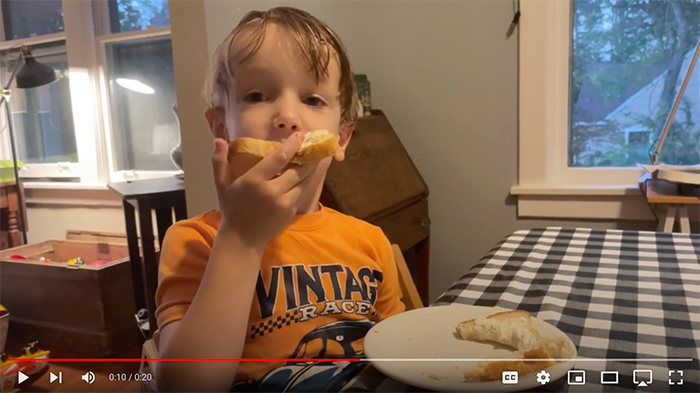
Yet here I am, 12 years into working full-time with writers and creators helping them share their work to connect it with readers. So… why? Am I a sellout? A horrible “marketing guru”? I don’t think so. My days are spent in conversation with writers and artists. My wife is an amazing artist, my clients are passionate writers, my friends are creators of all sorts, and this is my youngest son earlier this week (click the photo to see him talk about himself as an artist):

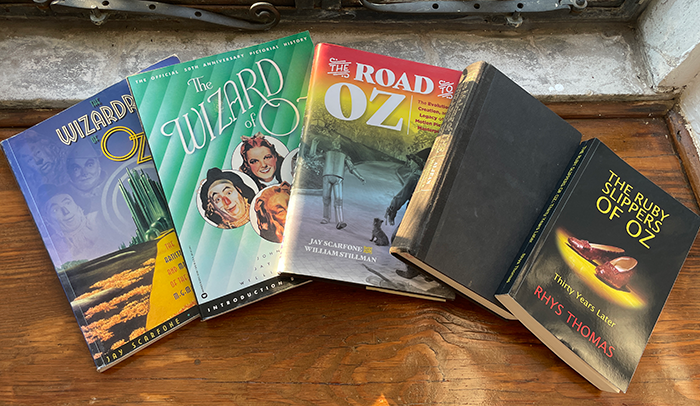
So, why would a writer or artist have to worry about marketing at all? Let’s dig into this topic. Where do we start? Well, with the Wizard, of course. You see, I have this obsession with the making of The Wizard of Oz. Here are some books from my collection:

Currently I’m reading the 1977 book, The Making of the Wizard of Oz, which is still considered one of the best researched narratives on the topic. I came to a passage that talks about how the movie got to become known as a classic, beloved by generations. You see, at first The Wizard of Oz received mixed reviews. Then it was a commercial failure, not earning back the money it took to make it until more than a decade after release.

We like to think that great art ALWAYS rises to the top. That it is always celebrated and remembered. But there are hundreds (thousands?) of movies from that era that were wonderful and they are… forgotten. And The Wizard of Oz may would have been forgotten except for two things, according to the author of The Making of The Wizard of Oz, Aljean Harmetz. The first:

“In 1956, CBS tried to lease Gone With the Wind from MGM for $1 million. MGM refused. As an afterthought, CBS made a $225,000 offer for The Wizard of Oz. MGM agreed and also gave CBS an option to broadcast the film annually. Without the once-a-year repetition on television as a special, the film would not have been seen enough times for a new generation to become aware of it. Nor would it have become an event rather than just a movie.”

I’m 49 years old, so I remember the yearly tradition of The Wizard of Oz playing on TV. Plus, the dozens of ads leading up to it, each promoting this as an event not to be missed. We would watch it as a family, because this was the days before VCRs, so this was your only chance to see the movie at all. For kids (and adults) in the 50s, 60s, 70s, and even into the 80s, it didn’t just give people access to the movie, it made them feel a part of a ritual. This was a shared cultural experience.

The second marketing reason that author Aljean Harmetz cited as a reason The Wizard of Oz is considered a classic today:

“Without Judy Garland’s unique voice and tragic future being tied to “Over the Rainbow” — so that one could never watch the frenzied self-caricature of her last years without being reminded of a time when rainbows were possible for her — the picture would never have taken on the qualities of poignancy, seriousness, and irony.”

This too, exists outside of the work itself. I know only as much of Judy’s life as I’ve seen in documentaries or movies about her, but I know that there are many people who have been obsessed with her through the years in a manner that they aren’t with any other Hollywood celebrity. She seems to have a singular role in how she affected some of her fans, even to this day. Judy’s life is part of what fueled continuing interest in the Wizard of Oz. Of course, vice versa applies too.

I hear from plenty of writers who feel that an author should never be seen or heard from. The book should “stand on it’s own” in the marketplace. But that isn’t quite how it happens. There is a train of people that lead each of us to a book. The editors, salespeople, librarians, teachers, friends, family, distributors, and so many others. Why not the author as well?

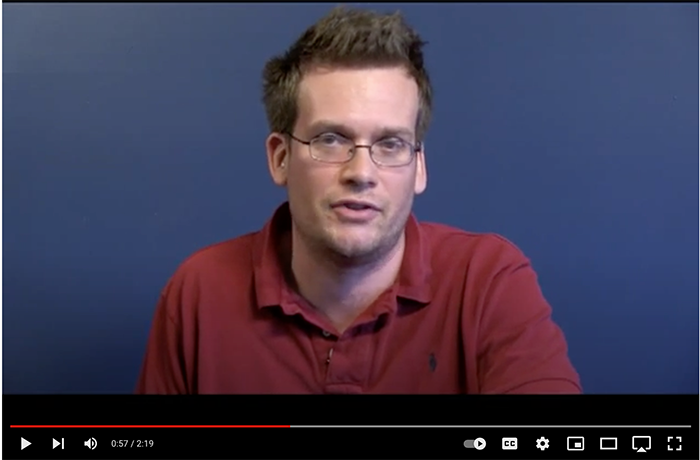
I always go back to this 2013 acceptance speech by author John Green. In it, he talks about how he is often held up as this example of a paradigm shift, of an author whose success is due to his incredible following on social media. Even though this is indeed partly true, he goes on to cite the large number of people responsible for his work reaching readers:


Should you — the writer — share your work? That’s up to you. All I can say is this: when I was younger and creating art projects in my bedroom in the 80s and 90s, I would have loved to have an avenue for them to reach more people. More people than my parents and the audience of stuffed animals in my room. Why? Because that art is gone. It never lasted. We share our work not to diminish our role as creators, but to celebrate the act of creativity, and that each of us has a voice. And sometimes sharing that voice is the respite that someone else needs in their lives.

Thanks.

-Dan

Prepare your author platform earlier than you think (podcast)

Regardless of the publishing path you choose, I encourage you to prepare your author platform for sharing your writing or publishing a book way before you think you need it. Like, years before. Today I want to talk about why that is.

You can listen to the podcast by clicking ‘play’ below, or in the following places:

You can watch the episode here:

Prepare your author platform earlier than you think

Regardless of the publishing path you choose, I encourage you to prepare your author platform for sharing your writing or publishing a book way before you think you need it. Like, years before. Today I want to talk about why that is.

Preparation is great when you consider this from a business standpoint: how to encourage success for establishing your presence as a writer, developing a network, selling your book, and growing your career as a writer. Preparation is also great for mental health as you work through all of this — you aren’t rushing to do everything at the last moment.

Recently I received a note from a writer who has been following my work for awhile. She’s read my book and been following my advice shared here in this newsletter. A year ago, she decided to take action on developing her author platform. This is while her book was still being edited, before she found a publisher. Recently, things began moving very fast for her manuscript: a publisher was interested and sent her an author questionnaire to fill out, which asked all about her platform as a writer, her marketing plans, how she will talk to readers about her book, etc.

Was she a deer in headlights trying to figure all this out? Nope. She was prepared.

She simply copied and pasted from the work she had already been doing in developing her platform. But even more, she said she felt total confidence in this because she had taken the time to figure it all out. She wasn’t guessing or hoping, she knew. I mean, just imagine having that feeling in the moment where you sense that you are on the cusp of your writing goals becoming a reality.

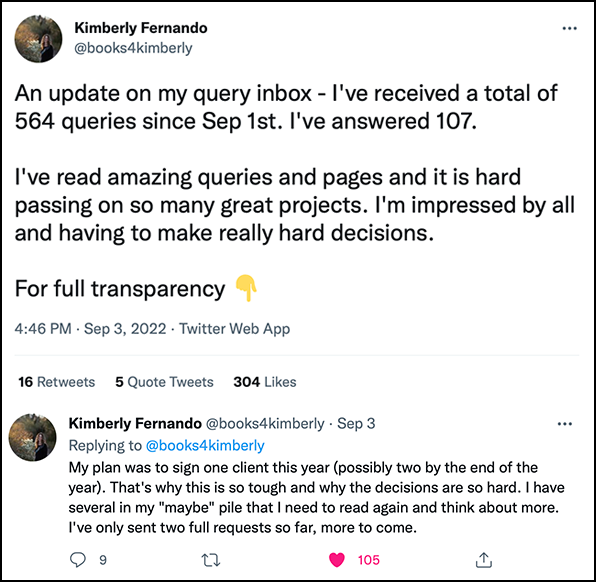
Last week on Twitter I saw a literary agent who was opening to queries on September 1st. A day later she posted this:

“I may have to make adjustments to my response timeline – I received 403 queries today, and there are still a couple hours or so left in the day. 🥰
Normally, I think that number of queries is what an average agent sees in a month! Thank you all for querying me!”


And another day later she updated:

“An update on my query inbox – I’ve received a total of 564 queries since Sep 1st. I’ve answered 107. I’ve read amazing queries and pages and it is hard passing on so many great projects. I’m impressed by all and having to make really hard decisions. My plan was to sign one client this year (possibly two by the end of the year). That’s why this is so tough and why the decisions are so hard. I have several in my “maybe” pile that I need to read again and think about more. I’ve only sent two full requests so far, more to come.


One author replied back:

“It is important for me to understand what I am up against. We hear how big the slush pile can be and can now see how hard it is to make an impression. Thank you.

Of course, what matters most in this process is that you write a good book, and that it resonates with anyone you hope to reach, which may (or may not depending on your publishing path) include a literary agent.

It is useful to see the actual numbers. This agent’s goal is to sign one new client, and with days she has hundreds of requests. Even if you are pursuing a different publishing path, perhaps going hybrid or indie, the scale of numbers still applies. If your book is released on a random Tuesday, there may be hundreds of other books published that day, and bunch in your specific genre or topic. And let’s not even multiply that by how many others are published in the days before and after.

Now, I am not in any way shape or form trying to discourage you from creating and sharing. I’ve recently been revisiting why I do the work I do, helping writers share what they create and ensure their work connects with readers. And it’s this: I deeply believe that every single person can create and share their voice. I love — LOVE — that we live in an age that anyone anywhere has the option to write and have that work distributed to others. That what they publish reflects what they want to see in the world, whether that is fiction, memoir, nonfiction, poetry, etc.

This is why I focus so much on having a system for you to communicate and develop your author platform. It’s why I wrote Be the Gateway, why I developed Human-Centered Marketing (read more here and here), the Creative Success Pyramid, and why I continue to add to these systems every single week through the work I do with writers. It’s also why I’ve sent this email newsletter every single week for more than 15 years. See the archives here.

The other day I was speaking with a writer who has published many books for years, and when talking about her next book and how she will reach readers, she said to me: “This all feels daunting. This is my last ditch effort to reach people who want to read my books.”

This work that we do — writing and sharing — isn’t easy. It asks so much of you to share what matters most to you. To put it out there for others to see. To try to connect it in a meaningful way to another human being. But I am reminded, this is not work we have to do, it’s work we get to do. I grew up as an artist and my wife is an artist, and believe that what you create does not have to be shared. There is immense value in you creating just for yourself. In you simply immersing yourself in the creative process for its own sake.

But if you want to share. If you feel compelled to share for any reason, I encourage you to start early. Way earlier than you think. Develop a system for how you will communicate what you create and why, and how you will develop a sense of trust with others.

I want to end this message with a special moment that one writer is experiencing. This week I taught an online workshop and at some point within it I mentioned that people tend to really respond when you post a selfie on social media. That you will often get more engagement when people can see you. Well, author Diane Byington, Ph.D. emailed me the following morning saying this:

“You said something about how people respond better to personal things like photos, so I took a picture of myself and posted it on Twitter. I’ve now passed two thousand likes and nearly a thousand comments, and things are still going strong. I can’t believe that the response has been so big. Thanks for the encouragement. This is great!”

The results as of this morning? 22,000 likes, 7,000 comments, 1,000 people resharing her message. Here is the post:
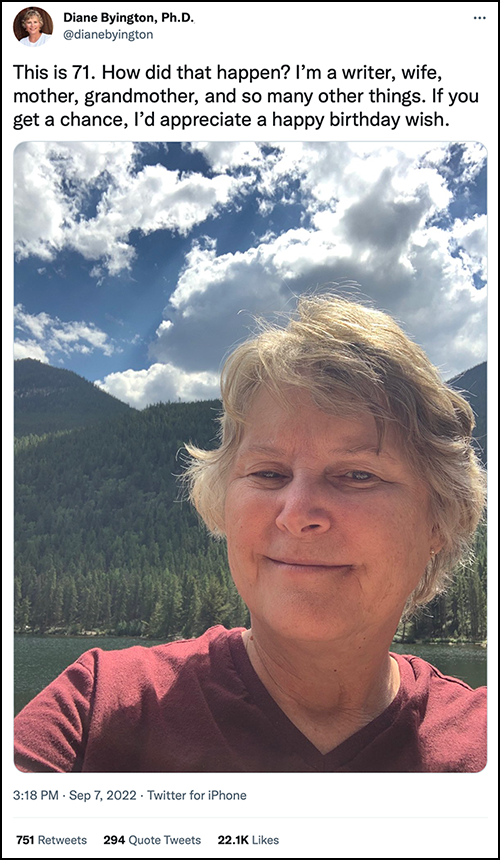
 

She has also picked up hundreds and hundreds of new followers because of this update. What happened? We aren’t 100% sure yet, but clearly Twitter is recommending it to people. Her message and image obviously resonates with people, as does the prompt to wish her happy birthday.

The more you prepare, the more you are ready for these moments when they happen. To keep engaging those new followers. To continue your journey of sharing your writing, your message, and filling your life with conversations and experiences around the themes and ideas that matter to you.

Thanks.

-Dan