To engage readers: be consistent & delight them

Today I want to discuss two strategies for effectively marketing your writing that may seem to conflict with each other. Yet, both are essential. Here they are:

  1. Consistency Matters
  2. Delight and Surprise Your Audience

Let’s look at an example. This is a chart showing the growth in subscribers to an email newsletter. It’s similar to what a writer I’m working with is experiencing:

 

The line going from the lower left to upper right represents the number of newsletter subscribers. So you see two things here. The first is the big jumps, where there is a steep incline illustrating rapid subscriber growth. These were moments when something that the writer shared went mini-viral, or where they were featured by someone else who has a large audience. They are moments of “delight and surprise” where you message resonates and spreads rapidly.

Then you see the periods in between those moments, where there is slow but steady growth incrementally, one subscriber at a time. It is not as dramatic, but that is the difference between ending the week with 10 new subscribers than when you started. This is the value of consistency. Of sharing regularly, connecting often. That between periods of viral growth is steady growth.

Okay, let’s dig in to both strategies:

Consistency Matters

Last week I talked about understanding your goals as a writer to grow your platform, and focusing on conversion. So of course, this could be milestones such as book sales, book reviews on Amazon, newsletter subscribers, speaking invites, Instagram followers, etc. When you know the actions you want people to take, and you consistently focus on encouraging those actions, you will likely experience growth towards your goals.

So: just be consistent.

The other day I was reading an article about the advice that a leader in the technology space was giving to the many companies they work with. The context was how to plan for surviving an economic downturn. Among their advice:

“You can often pick up significant market share in an economic downturn by just staying alive.”

My translation: just focusing on the basics can ensure that your vision lasts and grows, even as others stumble in a difficult market. There is that famous quote that “80 percent of success is just showing up.” I’m simply encouraging you to consistently:

  1. Share your voice.
  2. Show up in the lives of your ideal readers.

Focus on the basics and do them well. This doesn’t sound difficult, but so many writers miss it. Whenever I’m helping an author create or optimize their website, we will look around at websites from comparable authors. What do we often find? That it’s easier than you think to create a great author website, because so many others seem to be filled with errors or missed opportunities.I am not trying to be judgemental or negative here. But what we often find on websites:

  • A contact form that gives an error when you try to use it.
  • A bio that is wildly outdated. It ends with something like, “I’m looking forward to good things to come in 2016!”
  • Banners on the homepage that are outdated: “Pre-order my book now! Publication date: September 2019.”
  • Dead ends: they still link to their Google+ account (this entire social network no longer exists) and to their Tumblr account, which they last updated in 2014.
  • Missing information: They don’t mention their new book, where they are speaking, or even the link to their Instagram account where they show up every day.

So just getting the basics right — accurate and updated information — will make your website be more effective than others.I’ve said this many times, but your platform as an author is about communication and trust. Your ability to share what you care about in a meaningful way, and to develop a sense of awareness and trust with those you do connect with. Consistency does that. What is the opposite? The old expression: “fly-by-night.” Someone who drops in when they have a book to sell, then disappears until they have another book to sell you years later. When you only show up in the lives of your readers when you want a transaction, it is no surprise that the readers feel that their connection to you is “transactional,” based on what you want from them.

When working with my writing clients, we develop an entire system to stay consistent in how they share. We develop their messaging, editorial calendar, schedule, and so much else. This doesn’t have to be complicated. Consider: how can you share your voice once a week? How can you show up in the lives of your readers once a week? Start there.

Delight and Surprise

What do your readers really want? From your books? From your appearances at book readings? From your sessions at a literary festival? From the essay you publish in a major publication? From your email newsletters? From your social media? They want to be delighted and perhaps surprised. This can happen in many ways:

  • The memoir reader who is surprised to finally feel seen in your story. They are shocked that someone put into words what they have felt their entire lives. It is a respite during a difficult year, the rare moment of delight.
  • The nonfiction reader who was surprised to find a truly compelling new way to approach a topic. And one that empowers them to take practical steps forward in a way that feels totally doable. For the first time in a long time, they feel delight in approaching this topic in a meaningful way.
  • The fiction reader who wants a story to grab them in an unexpected way. They want to read long into the night, and find that your book has allowed them to enter a compelling new world that sets their imagination on fire.

Yes, this can happen in a Tweet. An Instagram post. An email newsletter. It is common for someone to spend their day under the weight of responsibility. To their job. Their family. Their obligations. They look at social media hoping for something to pause on. Something that will delight and surprise them. They look to their email, to events, to essays for the same reason.

The “social” aspect of social media allows them to find this by seeing what others are talking about. To feel a part of this discovery process, and the conversation and reactions that happen because of it. Just like, decades ago, you would go to the office or show up somewhere, and everyone was talking about some TV show from the night before. You wanted to be a part of it.

The people who follow your work want a meaningful experience. That can be deep. It can be fun. It can be somewhere within the full range of human emotions. Create experiences for those you connect with. Delight and surprise them.

I spend a ridiculous amount of time on YouTube. What is the biggest thing on that platform? Reaction videos. These can be many things across a wide range of topics:

  • Unboxing video
  • Video game reactions
  • Song reaction videos, where someone listens to a classic song for the first time
  • Trick shot videos where it takes thousands of tries to get it right
  • Yard sale hunts and hauls
  • Yard cleanups
  • Building things, which covers a wide range of industries, from cement contractors to cobblers

I went to YouTube just now and immediately saw these three videos being recommended to me, all of which focus on reactions:
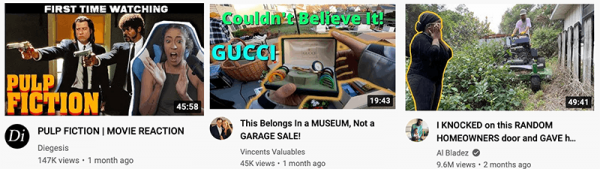
 

What will she think of Pulp Fiction? What did that person find at a yard sale? What will the woman’s reaction be to the yard cleanup? With a simple thumbnail and headline, they tease delight and surprise. Why are reaction videos so big? Because they promise the unexpected. They promise a real human moment. There is anticipation built in, and then… WOAH!!!! SOMETHING TOTALLY UNEXPECTED! SURPRISE! And… delight.

When working with writers, we focus on identifying their ideal audience with a great deal of specificity. We then conduct marketplace research to identify where those readers show up and what engages them. In doing so, we gain a lot of insight for how to come up with messaging, a content strategy, and marketing that can help reach their readers.

You may be looking at that chart at the top of this email and thinking, “Hmmm, it seems that ‘delight and surprise’ is where most of the growth comes from. Why not just focus on that, and not worry about consistency and systems?” And there is definitely a logic to that. The issue I have found is that consistency creates the opportunities to delight and surprise. It pushes you to create and share more often, increasing the likelihood of something delighting and surprising. You don’t always know what will go viral. But showing up to create and share consistently ensures you will find something… eventually. And in the meantime, you are sharing your voice and growing your audience. One day at a time, one person at a time.

And isn’t that the life of the writer and artist?

Thanks.
-Dan
4 critical steps to growing your audience (podcast)

Today I want to talk about how to reach your goals as a writer. That may be book sales, or book reviews, or appearances, or getting essays published, or developing a following, or so much else. I will cover four key areas from a marketing perspective:

1. Proximity Matters
2. Focus on Conversion
3. Understand The Marketing Funnel
4. Double Down

You can listen to the podcast by clicking ‘play’ below, or in the following places:

You can watch the episode here:

4 critical steps to growing your audience

Today I want to talk about how to reach your goals as a writer. That may be book sales, or book reviews, or appearances, or getting essays published, or developing a following, or so much else. I will cover four key areas from a marketing perspective:

  • Proximity Matters
  • Focus on Conversion
  • Understand The Marketing Funnel
  • Double Down

Okay, let’s dig in…

Proximity Matters

So I’m reading the autobiography from an actor. It’s not someone I care about one way or another, but I simply heard the book was good. It’s Stories I Only Tell My Friends by Rob Lowe.

Early in his life, he lived in Dayton, Ohio, and found it difficult to catch a break with acting or entertainment. His big accomplishment at the time was being part of a singing group called “Peanut Butter and Jelly.”

But then, his mom moved his family to Malibu, California, not for any reasons related to acting. Suddenly, we see how proximity matters:

  • His neighborhood friends who he shot student movies with? Emilio Estevez, Sean Penn, Charlie Sheen, Chris Penn, and others who would find success later on. His house was 4 houses away from Martin Sheen.
  • He was classmates with a young Robert Downey, Jr. and hung out with Tom Cruise before either were famous.
  • The TV Show Charlie’s Angels recorded an episode at his brother’s school, so Rob showed up and asked advice from the people working on set. Someone told him, “Write a letter to Aaron Spelling, who produces this show.” Rob did, and got a reply back.
  • At a Dodgers game, he met the head puppeteer on the Muppet Show, who invited him to visit the set and show him how the production works.
  • At a different game, he also met someone who would later become his agent.
  • His aunt and uncle worked special effects on Star Wars, and gave Rob an early visit to the studio during filming. He saw all the ships and costumes a full year before the rest of the world.

Did any of these specific connections lead to later success? Nope. But he was immersed in the industry, developing his network, and undoubtedly these experiences and connections helped in some way. He was able to understand the true inner workings of various aspects of the entertainment industry. He could see how a sound stage worked long before he was paid to set foot on one. He would have hundreds of conversations of the experiences of other actors and filmmakers, as he formed his own trajectory in the industry.

This reminds me of an interview I once heard with MTV VJ Martha Quinn, who shared the best advice she was ever given:

“Martha, you’ve got to get in the life. You’ve got to go where the life is happening that you want to be in.”

She concluded: “Be involved in whatever you want to be.” The context is this: Martha wanted to get into radio or journalism, and the result of that advice was that she moved to New York, where she got the gig to launch MTV.

This is why I encourage you to show up where your ideal readers are. Because even that prompt begs so many other questions for you to research: who are my ideal readers, what else do they read, what engages them, who do they follow, where do they show up, and on and on.

Proximity matters. If you are distant from your readers, if you don’t know who they are, where they show up or how to engage them, is it any surprise when they don’t magically appear when you release your next book?

Find your ideal readers. Then go to where they are. Get involved. Have conversations. Be a part of what they are a part of.

Focus on Conversion

People who succeed often focus on conversion. That is a sales term. A “conversion” is when someone goes from being a prospect to a customer. That is sometimes when money changes hands, but a conversion point can be many things: a subscriber, a follower, speaking at a book club, getting book reviews, etc. Consider: what is the one metrics that matters most to you?

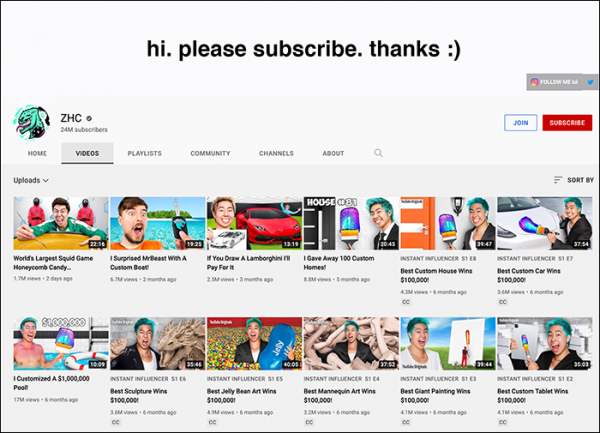
The other day I was watching a video that showcased artist Zach Hsieh’s rise on YouTube. He now has 24 million subscribers. MILLION. And half of those he amassed in a single year. It’s astounding.

I hadn’t heard of him before, so when I went to his YouTube channel I saw this as his banner up top:


Here is someone who has more subscribers than any of us can imagine. The very first thing he asks? “Please subscribe.”

This is someone who is laser focused on the conversion point — the metric — that matters most to him and his business. To get that subscriber leads to various ways he can engage with a member of his audience. Which leads us to…

Understand The Marketing Funnel

So many writers and creators focus on the idea of getting a sale for their book, but they don’t understand the journey to that sale. The sale of your book is not the goal. It is part of a much longer process of someone becoming aware of your work. Considering it. Testing it out. Engaging with it. Then… finally… they buy your book.

But that isn’t the end.

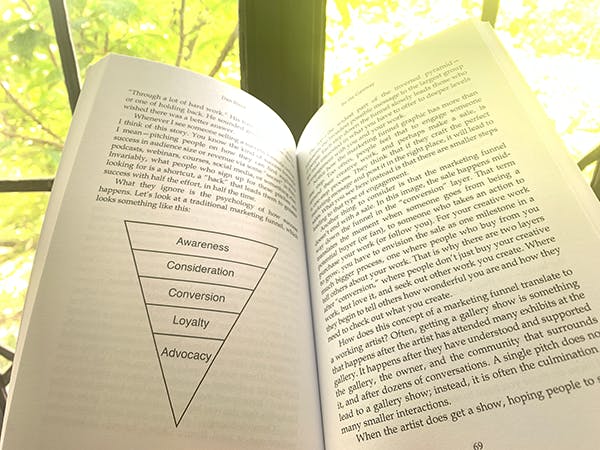
Your hope is not just for $10 or $15 or $20, is it? No, it is for them to read the book. To appreciate the book. To have it move them. Perhaps then you hope they leave a review, or tell a friend, or support your work in some other way, or buy your next book. The book sale is only midway through the marketing funnel. This is a typical marketing funnel (from my book, Be the Gateway):


Conversion is only halfway through it. From there, you hope to develop true fans of your work, who will recommend your books to others and look forward to what you write next.

Consider that progression to your conversion points. Where you create value, and where you have meaningful engagements with your ideal readers. Because your platform is not how many followers you have. It is how much trust a single reader has with you.

Double Down

You can’t half bake this. If you truly want to reach your goals as a writer, I encourage you to double down it on. To care about it more than anyone else will, because, well, that’s the reality.

Go beyond “best practices.” Why? Well, if pursue “best practices,” that means you are doing barely enough. A copy of a copy of a copy of what everyone else is doing. In the most minimal manner.

Recently I’ve been researching the career of Quentin Tarantino. Do I particularly like him as a person? Nope. Do I agree with all of his decisions? Nope. So what am I learning from his career? Well, it goes back to a quote from many years ago from Scott Johnson:

“Caring is a powerful business advantage.”

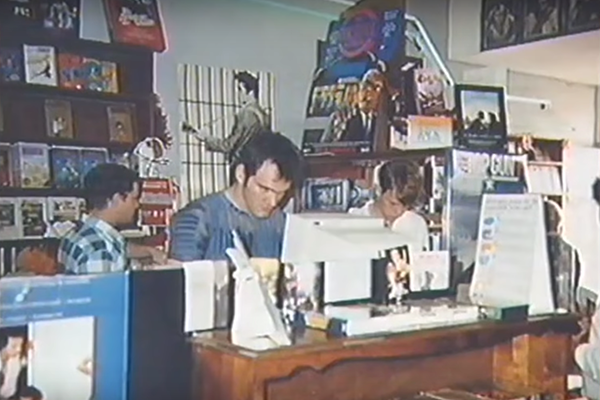
Quentin loves movies and is legendary for his research and obsession with them. It’s fascinating to listen to how he crafts a movie, the level of detail, to hear him talk about aspects of film I had never before considered, and hear from others who tell stories of his total obsession with film. Here is a photo of him before he became a filmmaker, of course, working at a VHS rental store. Everyone working in this store would say they love movies. But with Quentin, it went to a whole new level:


What resonates with me about people who succeed in their creative field is their depth of focus. Their ability to care more about this than anyone around them. A lot of times that just comes down to getting involved, having conversations and experiences. For Quentin that was simply spending thousands of hours… watching movie. Reading about movies. Experiencing movies.

I am listening to an hourlong podcast with Quentin where he lists every movie he saw in the theater in 1979. He was 16 years old that year. Let me ask you: how many movies did you watch when you were 16? Well, for Quentin, it was more than 65 movies. In the theater! But more than that, as he discussed them, he talked about who the directors were, who the cast was, he put each movie in context, but also honed in on details. And that’s just one year from his life. A typical comment from a listener of this episode:

“Being about year older than Tarantino I can totally relate to all of this…I’ve seen and heard of most of these films, but even NOW there are a few films mentioned here I’ve NEVER heard of until now haha…and I thought I was a fairly well-versed film buff, but Tarantino has me beat on that one by a country mile. He’s a virtual walking encyclopedia of film going back to the earliest Hollywood movies INCLUDING [international] films.”

Maybe you can’t move to the city you feel your career may thrive. But thankfully, because of the internet, you can email nearly anyone. You can show up to online groups and virtual events. You can follow and engage with like minded people through a variety of channels online. And you can share your voice. This is powerful, so much more powerful than we make out.

I’m sure if I walked into that video store in the 1980s, Quentin would have a powerful voice about what I should and shouldn’t watch. But when I left those walls, his voice would disappear.

Today, with newsletters and social media and email and video and so much else, your voice can move beyond the four walls where you sit. That is an opportunity in developing your author platform, if you want to take it.

How you share is a craft. Oftentimes your focus should not be on constantly following the latest trend, but going deeper into these strategies:

  • Proximity Matters
  • Focus on Conversion
  • Understand The Marketing Funnel
  • Double Down

Thanks.
-Dan

Creativity is work

Join me on Wednesday May 25th for a free online event with Jennie Nash: “How to Get People to Care About Your Writing.” We will dig deep into the topic, plus celebrate the launch of her new book: Blueprint for a Nonfiction Book! Register here. Onto today’s message…

I said something in a workshop for writers recently that seemed to resonate with some of them. It was an offhand comment, but something I believe in deeply:

Creativity is work.

The context for this was to encourage the writers to show up for this work. To not wait until they have ample time and energy, when everyone around them has made it easy for them to be creative. You have to prioritize this time, even when others dismiss it. You have to create systems around it to do so. You have to mentally and emotionally prepare to work through your inner boundaries to get there. All this, just for the opportunity, to create. And the same goes for sharing what you create, which is the work I help writers do.

Should it always be that way? Gosh, I hope not. I genuinely hope you find creating easy. That it is magical. That it flows. That your life opens up to make room for it. And while I have had periods in my life where that has happened, it is not the norm. It is work, to show up for your creative vision.

I’m married to an (amazing) artist. Of course, inspiration fuels her. But I see her show up… every day… for her creative vision. I see her work.

My friends have always been creators. Dancers, visual artists, designers, writers, performers, and the like. We had this special wing of our high school for a performing arts program. I would see my friends show up for that work. A line of dancers along the wall… working. A group of students huddled over the video editing bay… working. The actors sprawled out in a hallway building sets… working.

When I was young, it seemed like so many people were talking about creative goals. Thirty years later, how many of them are still pursuing those goals, even as a small hobby? Whoever is, is working at it. And of course, this is how my days are spent with writers: showing up to do the work of developing their careers, of understanding who their audience is, forging meaningful connections with readers, and sharing their writing.

This doesn’t just happen. Not usually, anyway. You have to show up for that work.

Eight years ago Jennie Nash and I began meeting once a week to discuss creativity and business. We showed up for each other’s goals and challenges each week. The phone calls are not social, they are not chitchatty. They are us doing the work. We get on the phone, and one of us is immediately like, “YOU GO FIRST.” We each come prepared with specific challenges that we would like feedback on. We are never subtle. There is no “Oh, the week is fine, you know, just soooo busy.” It is always: “I’m losing sleep over this thing, let me present to you the decision I’m working on for this tiny aspect of my business (or creative work)…” Of course, we are incredibly supportive of each other, but we also call each other out on habits that need to change, on perspectives we are missing, and on flipping ideas entirely on their head.

Every. single. week.

Creativity is work. And you have to show up for it. So is how you share that work. Which is why Jennie and I are hosting the free event next week on “How to Get People to Care About Your Writing.” You see, Jennie is a book coach, and even established an entire company where she trains book coaches. More than 100 people have been certified as book coaches through her program. That’s amazing. To not just create, but empower others to do so as well.

Whether you intend this or not, I think that is what writers do through what you create. Whether fiction, memoir, nonfiction, poetry, or any kind of writing, you are creating a gateway for readers. You open up new worlds, new ideas, new experiences for readers. For many people, just to read a book can be work. How many books have you purchased that you never read? Or never got past the first chapter, even if you intended to? This is common. I was chatting with a writer just this week who told me, “I bought your book when it first came out. But I haven’t read it yet.” This happens all the time. I speak with writers who are shocked that their closest friends or family haven’t even bought or read their books. Of course we hope that they say, “I stayed up all night… I just could not put it down!” We hope for books to be a magical force, just as we hope creativity to be that as well. But that doesn’t always happen.

In the same way, your writing will not just magically get shared. People have to take that action. Yes, we hope that readers will love what you write, and feel compelled to share it. But as anyone who has ever published a book knows, that isn’t always true. It is work. Which is why I help people learn how to develop their identity as a writer, understand who their ideal readers are, and connect them with this writing in meaningful ways. Like, that is my whole career: to learn how to share what we create.

All of this is a craft. Of how we connect. How books bring us together. How what you create becomes part of who you are, and your daily experience in this world. Not as… “I created a product that you can buy in a retailer.” But as “My days are filled in creation and conversation around the ideas and themes I love, with people who think about them in a similar way that I do.”

Often writers view the goal of sharing their work as: “How do I grab people’s attention so that they see my book?” But that isn’t the goal. It’s how you can share what you create in a meaningful way with real people. How doing so leads them to be curious about the story you share. It’s about them loving it, and then, sharing it with others.

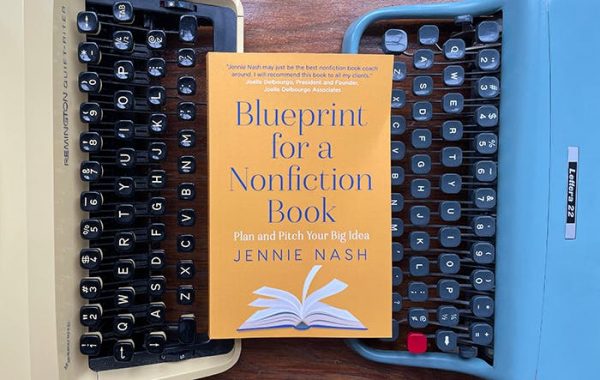
Jennie is doing that right now. She just published a new book, Blueprint for a Nonfiction Book: Plan and Pitch Your Big Idea:

Writing this book, publishing it, sharing it, that is all work she is doing in addition to so much else in her business. But this is her living her mission, constantly in conversation with writers and those who support them.

Likely, you don’t have any kind of business around what you create. You want to write and have people read it. I am simply encouraging you to show up for that work fully. To not shy away from doubling down on it and on the power your own voice. On sharing it like you feel it truly matters not just to you, but to others.

This week I shared my latest podcast interview with author Corie Adjmi. She shared how she grew up in a house full of athletes: “In the bookcase in my house, there were very few books, but a lot of trophies. But they always gave me the opportunity to take classes.” That support translated into a life of dance, art, and then… writing. In releasing her first book, she described her ethos of the launch process: “This is fun! How can I be creative in showing people my book, and sharing what’s inside, and what kind of great conversations can we have? And it has been amazing, a really busy two years.”

Corie and I worked together awhile back, and it feels great to share her perspective on sharing her work as fun.


Pease join me on Wednesday May 25th, for my event with Jennie nash: “How to Get People to Care About Your Writing.” We will dig deep into the topic, plus celebrate the launch of her new book. Register here.

Thanks.
-Dan

“I’m so happy to be writing, I feel like this is where I was meant to end up,” with Corie Adjmi

Growing up, Corie Adjmi was always experimenting with creativity, but grew up in a house full of athletes: “In the bookcase in my house, there were very few books, but a lot of trophies. But they always gave me the opportunity to take classes.” That support translated into a life of dance, art, and then… writing. In this conversation, Corie shares her journey to her life as an author. Plus, how she describes her ethos for her book launch: “This is fun! How can I be creative in showing people my book, and sharing what’s inside, and what kind of great conversations can we have? And it has been amazing, a really busy two years.”

You can listen to the podcast by clicking ‘play’ below, or in the following places:

You can watch the episode here:

You can find Corie in the following places:
corieadjmi.com
Her books:
Life and Other Shortcomings
The Marriage Box
Instagram: @corieadjmi
Twitter: @corieadjmi